


False Positives in AML: Why they happen and how to reduce them without weakening detection

AML false positives occur when transaction monitoring, sanctions screening or KYC controls flag legitimate customers or activity as potentially suspicious.
Firms can reduce them without weakening AML detection controls and framework. The harder question is how far a firm can reduce alert volume without creating blind spots and what a supervisor will expect to see when it asks how those reductions were achieved.
This article explains what AML false positives are, why they happen in transaction monitoring and screening, and how financial institutions can reduce them defensibly.
AML False Positives - Key Takeaways |
|
|
|
|
|
|
|
What is a false positive in AML?
A false positive in AML is a customer, transaction or business relationship that an AML control flags as potentially suspicious, or as a possible sanctions or PEP match, but which review determines does not represent the suspected risk.
Statistically, it is a Type I error: the system says “yes” when the correct answer is “no”.
A false positive is not automatically an analyst error or a compliance failure. Risk-based AML controls are intentionally calibrated to detect activity that warrants review, so some proportion of alerts will inevitably turn out to be legitimate.
The compliance risk comes from what happens next: whether the alert is investigated properly, whether the disposition is documented, and whether the outcomes are used to improve the control environment.
Two simple examples illustrate the distinction.
A payment is stopped because the beneficiary's name closely resembles a person on the UN Consolidated List. The customer is a 34-year-old engineer in Sharjah, while the listed individual has a different date of birth and nationality.
After verification, the institution establishes that they are different people. That is a screening false positive.
A retail customer receives AED 180,000 through three transfers in one week and triggers a transaction-monitoring velocity rule.
The customer provides evidence that the funds came from the sale of a car. The rule identified unusual activity as designed, but the activity is ultimately not suspicious.
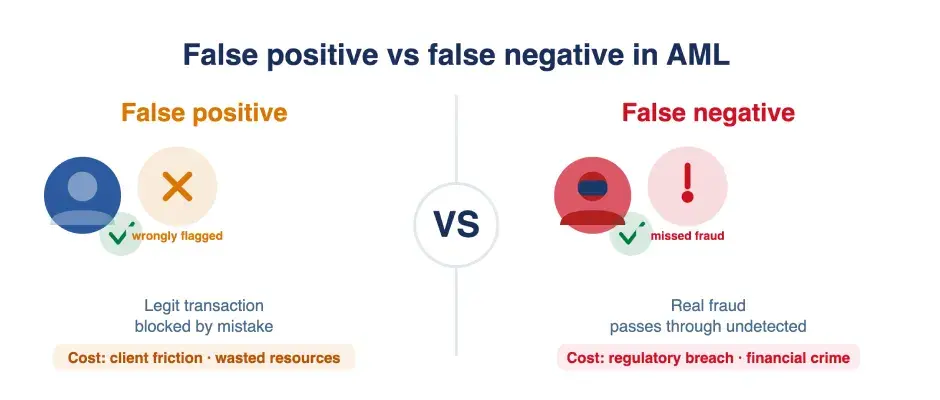
What is the difference between a false positive and a false negative in AML?
Every calibration decision affects the balance between two types of error:
A false positive sends legitimate activity for review.
A false negative is more serious: potentially suspicious activity passes through the control without being identified.
False positive | False negative | |
What it is | Legitimate activity flagged as potentially suspicious | Suspicious activity that the control fails to identify |
Operational cost | Analyst time, onboarding or payment delays, customer friction | Potentially no immediate signal that anything was missed |
Risk impact | Consumes investigative capacity | Creates undetected ML, TF, PF or sanctions exposure |
Control implication | May indicate inefficient calibration | May indicate insufficient detection coverage |
The two errors are not symmetrical. Reducing false positives is useful only if the change does not materially increase the risk of false negatives.
That is why threshold changes, suppression logic and model tuning should be treated as control decisions rather than purely operational efficiency measures.
Where do AML false positives come from?
AML false positives generally originate in three control families: sanctions and PEP screening, transaction monitoring, and onboarding or KYC controls.
They do not necessarily share the same root cause. A firm can spend months tuning transaction-monitoring thresholds while most of its unnecessary workload is being generated by poor screening data.
Control | Typical alert | Common causes | Where remediation sits |
Sanctions, PEP and adverse-media screening | Potential name or entity match | Broad fuzzy matching, insufficient secondary identifiers, transliteration differences, weak aliases | Screening configuration, data quality, list management |
Transaction monitoring | Threshold breach or unusual activity pattern | Weak expected-activity profiles, poor segmentation, inappropriate thresholds, data mapping problems | CDD, scenario design, segmentation, data architecture |
Onboarding and KYC controls | Identity, document or data mismatch | Incomplete capture, inconsistent records, unstructured data | Onboarding workflow and data standards |
The first step in reducing false positives is therefore not “raise the threshold”. It is identifying which control is creating the noise and why.

Why do sanctions and PEP screening generate false positives?
Screening systems compare data points. They do not inherently know that two similar-looking names belong to different people.
If a customer called Mohammed Al Amiri is compared with Mohammed Al-Ameri on a sanctions or PEP database, the system may correctly decide that the similarity warrants review. Whether the two records refer to the same person must then be established using additional information.
The volume of screening alerts is influenced by matching logic, customer data quality, list selection, aliases and the linguistic characteristics of the population being screened.
How does fuzzy name matching affect false positives?
Fuzzy matching identifies names that are similar rather than identical.
This is important because sanctioned or high-risk parties may appear under different spellings, aliases or transliterations. However, increasing matching tolerance also increases the number of unrelated names that can be flagged.
CBUAE guidance expects sanctions screening criteria to be calibrated to the institution's sanctions risk and allows the approach to vary across customers, products, services, delivery channels and geographic exposure.
For compliance teams, the objective is therefore not to eliminate fuzzy matching. It is to calibrate it so that meaningful variations are captured without producing an unmanageable number of irrelevant matches.

Automated Digital Onboarding
Transform end-to-end onboarding with customised flows tailored to your business needs using our secure solution.
Why are Arabic names and transliteration important in GCC screening?
Arabic transliteration is a major source of screening complexity for institutions operating in the GCC.
The same Arabic name can be rendered in Latin characters in several legitimate ways. Mohammed, Mohammad, Muhammad and Mohamed may refer to the same Arabic name. Prefixes and definite articles may also appear as Al Amiri, Al-Amiri or Alamiri.
Long patronymic naming structures create further variation when one system stores the complete name, and another truncates or rearranges individual components.
A matching engine configured primarily around Western naming conventions may therefore generate substantially more manual review for a Gulf-heavy customer population.
The practical response is not simply to narrow matching tolerance. Institutions should combine name-matching logic with reliable secondary identifiers and ensure that transliteration behaviour is reflected in testing and calibration.
Why do secondary identifiers matter?
A name can generate a potential match. Secondary identifiers help establish whether it is a genuine one.
Useful identifiers include:
Date of birth
Nationality
Place of birth
Address
Identification or passport details
Legal-entity registration data
CBUAE guidance specifically expects LFIs reviewing potential sanctions matches to compare available information such as date of birth and address with the designation information and, where necessary, obtain additional identification information.
This makes data quality one of the most effective ways to reduce screening workload without reducing detection coverage.
When date of birth, nationality or address fields are missing or unreliable, common-name hits become manual research exercises.
Learn more about Anti-Money Laundering compliance in the UAE

Should firms screen every available list and alias?
More screening does not automatically mean better screening.
The relevant regulatory lists must be covered, but additional lists, PEP sources, adverse-media sources and internal watchlists should be selected according to the institution's legal obligations and risk profile.
For targeted financial sanctions in the UAE, Cabinet Decision No. 74 of 2020 remains active and requires relevant screening against the applicable UN and UAE lists.
Weak, generic or low-quality aliases also deserve careful treatment because they can create substantial numbers of potential matches with limited identifying value.
Read also: Adverse media screening

Why do transaction-monitoring rules generate AML false positives?
Transaction monitoring compares what a customer is doing with what the institution considers expected, unusual or potentially suspicious.
If the baseline is poor, the resulting alert quality will be poor.
Transaction monitoring is downstream of customer due diligence: weak customer information makes effective monitoring harder. Common causes include:
1. Weak or outdated customer profiles
If a system has no reliable expected turnover, purpose of the relationship, customer occupation, business activity or anticipated transaction behaviour, ordinary activity can appear unusual.
Better CDD data gives monitoring rules more meaningful context.
2. Thresholds without customer or product segmentation
A single threshold applied across substantially different customer populations will generate unnecessary alerts.
The behaviour expected from a salaried retail customer is different from that expected from a cash-intensive restaurant group or high-volume payments business.
CBUAE guidance specifically expects risk-based customer and product segmentation so that transaction-monitoring parameters and thresholds can be calibrated to the activity being monitored.

Intelligent Transaction Monitoring
False positives overwhelm teams, leading to inefficiencies and missed risks. Leverage AI to monitor transactions continuously and flag suspicious activities instantly.
3. Data-quality and mapping problems
A well-designed rule cannot compensate for inaccurate inputs.
Incomplete transaction feeds, incorrectly mapped transaction codes, missing counterparty data, or inconsistent information between core banking and monitoring systems can all make normal activity look anomalous.
CBUAE guidance states that data feeding transaction-monitoring and screening systems should be tested and validated on a risk-based basis, typically at least every 12 to 18 months depending on the institution's risk profile.
4. Fragmented customer-level monitoring
When related accounts are assessed independently, the system can lose the context necessary to understand the customer's overall behaviour.
Where the institution's systems and risk framework permit it, consolidating activity at customer or relationship level can improve context and reduce repetitive alerts.

The End-to-End Compliance Platform
Streamline compliance from identity and business verification to corporate compliance and AML transaction monitoring, reducing costs and complexity so you can scale with confidence.
What do UAE regulators expect when firms reduce false positives?
UAE supervisors do not require institutions to maximise alert volume. They expect monitoring and screening systems to remain effective, risk-based, tested, documented and independently challenged.
A lower alert count can therefore be entirely defensible if the institution can demonstrate why the change was made, how it was tested and what controls remain in place to detect relevant risk.
There is also an important legal update for anyone relying on older AML material.
The CBUAE's 2021 Guidance for Licensed Financial Institutions on Transaction Monitoring and Sanctions Screening remains listed in the CBUAE Rulebook as in force. However, the underlying UAE AML legislation has since changed.
Federal Decree-Law No. 10 of 2025 is now in force, and Cabinet Resolution No. 134 of 2025 replaced Cabinet Decision No. 10 of 2019 as the principal executive regulation. Cabinet Decision No. 74 of 2020 remains active for targeted financial sanctions.
Within that framework, several expectations are particularly relevant to false-positive reduction.
Test thresholds instead of guessing
CBUAE guidance expects rule parameters and thresholds to be appropriately calibrated to customer and product risk.
For LFIs with larger transaction volumes, the guidance specifically refers to above-the-line and below-the-line testing: increasing and decreasing thresholds in a test environment and measuring the resulting output to fine-tune calibration and reduce false-positive alerts.
A material tuning decision should therefore be supported by evidence rather than analyst intuition alone.
Use suppression and whitelisting carefully
Repeated alerts with the same understood cause can sometimes be handled through risk-based suppression logic or similar techniques.
However, CBUAE guidance warns against applying such methods to higher-risk customers or transaction types without appropriate monitoring, testing, tuning and validation.
In sanctions screening, a documented whitelist can help speed up repeated dispositions where a customer has already been confirmed as a false match.
It does not end the screening obligation.
A person who is not listed today could be listed later, so customers and transactions still need to be screened against updated lists.
Report false-positive outcomes to senior management
False-positive data is not merely an operational metric. CBUAE guidance says management information may include:
Alerts produced by each transaction-monitoring rule
Proportion cleared as false positives
Proportion requiring further investigation
Proportion ultimately resulting in an STR or SAR
That analysis should feed back into financial-crime risk assessment and control decisions.
A high-volume rule that has generated no meaningful investigations for an extended period deserves scrutiny. So does a rule whose conversion suddenly changes after a system or data update.
TIP: Get our Free AML risk assessment template
Validate models independently
Testing and validation should be performed by people with sufficient expertise and an appropriate degree of independence from model development and use.
Where developers or users perform part of the validation work, that work should be critically reviewed by an independent party. Validation activity, weaknesses and remediation should be documented.
A vendor model is still the institution's responsibility
Using a third-party transaction-monitoring or sanctions-screening system does not transfer the institution's regulatory responsibility to the vendor.
CBUAE guidance states that LFIs remain responsible for compliance and are expected to validate their own use of vendor products, understand their assumptions and limitations, and assess whether customisation is appropriate for the institution's risk profile.
Read more: Anti-money laundering compliance program
What might a supervisor ask to see?
A defensible false-positive reduction programme should be able to produce evidence such as:
Current monitoring scenarios and their purpose
Parameters, assumptions and thresholds
Testing supporting material threshold changes
Data-quality and reconciliation testing
Suppression and whitelist procedures
Periodic review of suppression and whitelist logic
Alert volumes and disposition outcomes by rule
Independent validation records
Records supporting individual alert dispositions
Governance or approval records for material calibration changes
The objective is not to prove that every rule is perfect. It is to demonstrate that the institution understands how its controls behave and manages changes deliberately.
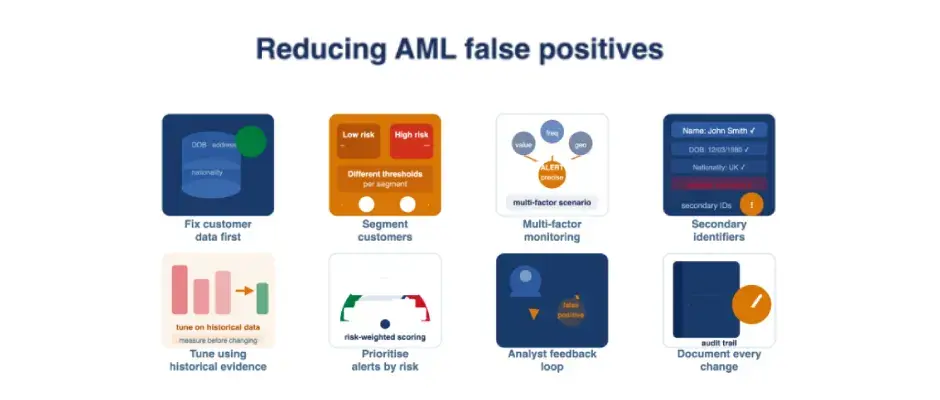
How can firms reduce AML false positives without weakening detection?
The most sustainable improvements usually come from better data, segmentation and scenario design rather than simply raising thresholds.
1. Fix customer data first
Improve dates of birth, nationalities, addresses and other identifiers used in screening.
For transaction monitoring, maintain meaningful expected-activity information such as anticipated turnover, customer type, source of funds and normal transactional behaviour.
2. Segment customers, products and activity
Different populations should not automatically share the same parameters.
Create segments that reflect actual differences in risk and expected behaviour, then calibrate thresholds accordingly.
Read also: AML customer types
3. Use multi-factor monitoring scenarios
A single monetary threshold is often a blunt instrument.
CBUAE guidance encourages grouping parameters into multi-factor scenarios that can identify transaction patterns associated with known illicit-finance typologies more precisely.
For example, a transaction may become more meaningful when value, frequency, customer risk, counterparty geography and change from historic behaviour are considered together.
4. Use secondary identifiers in screening
Name similarity should be the start of the review, not the end.
Adding date of birth, nationality, address or other identifiers can remove large numbers of irrelevant common-name hits while preserving sensitivity to genuine matches.
5. Tune using historical evidence
Before changing a rule, measure what would have happened if the new parameter had been in place previously.
Review both the alerts that would disappear and any potentially meaningful activity that would no longer be detected.

6. Prioritise alerts by risk
Risk-weighted alert scoring does not necessarily reduce the number of alerts generated, but it can reduce operational risk by ensuring that higher-risk cases reach appropriate investigators first.
CBUAE guidance recognises alert risk scoring as part of an effective transaction-monitoring and reporting framework.
7. Feed analyst outcomes back into calibration
Disposition data provides evidence about how rules perform in practice.
Repeated false positives, repeated alerting on the same explained behaviour and rules that rarely progress to investigation can reveal calibration problems.
The feedback loop should work in both directions: a rule that appears highly productive may also need review if it is missing important patterns outside the population it currently detects.
8. Document every material change
A control change should leave an audit trail, a specific record:
What changed
Why it changed
Who approved it
What data was used for testing
What the testing showed
What residual risks were identified
When the change will next be reviewed
After the fact, an undocumented tuning decision can be difficult to distinguish from an uncontrolled weakening of detection.

How should an AML false positive be closed and documented?
A false-positive disposition should show what triggered the alert, what information was reviewed, why the suspected risk was ruled out, who made the decision and when the review was completed.
An alert marked “false positive” with no supporting rationale provides weak evidence that the alert was meaningfully investigated.
How should a sanctions false positive be handled?
For UAE sanctions screening, CBUAE guidance states that when a potential match is identified, the LFI should suspend the transaction until it is satisfied that the party is not a listed person.
The institution should compare available identifiers, such as date of birth and address, with the designation information and obtain additional identification where necessary.
If the institution establishes that the match is a false positive, sanctions freezing measures are not required, and the transaction or relationship may continue in the normal course, provided there is no other suspicious activity or concern.
Evidence of the verification process must be retained and made available to competent authorities on request.
This should be distinguished from a confirmed match, where applicable targeted financial sanctions measures must be implemented without delay.
What if the potential match cannot be resolved?
An unresolved potential sanctions match should not simply be closed as a false positive.
Article 21 of Cabinet Decision No. 74 of 2020 includes reporting requirements where no action has been taken because a false positive could not be dismissed using available or accessible information.
CBUAE guidance specifically gives insufficient identifying information, such as date of birth, address or nationality, as an example of this situation.
This is different from a false positive that has been positively resolved.
How long should AML records be retained in the UAE?
Under Article 25 of Cabinet Resolution No. 134 of 2025, relevant transaction and AML records must be retained for at least five years.
Depending on the record, the retention period may run from the completion of the transaction, termination of the business relationship, account closure, completion of a supervisory inspection or investigation, or final court judgment, with the regulation specifying the applicable starting point.
What is a normal AML false-positive rate?
There is no useful universal target because a false-positive rate is heavily influenced by customer population, products, transaction volumes, jurisdictions, scenario design and the denominator used.
More importantly, optimising for a single percentage can create the wrong incentive: the rate can improve simply because the system generates fewer alerts.
CBUAE guidance instead points firms toward more informative rule-level and outcome-level metrics, including alert volume, the proportion cleared as false positives, the proportion requiring further investigation and the proportion leading to STR or SAR filing.
Useful operational metrics include:
Alert volume by monitoring rule or screening configuration
Alert-to-investigation conversion
Investigation-to-STR/SAR conversion
Alert ageing and backlog
Repeat alerts involving the same customer and behaviour
Screening hits confirmed as potential or true matches
Disposition time for higher-risk cases
Rules generating little or no investigative value over time
Changes in outcome rates after calibration or data changes
The goal is not simply a lower false-positive percentage. It is a better ratio between investigative effort and meaningful risk detection.

AI-Powered AML Solution
Leverage AI to design flows, identify risks, auto-flag suspicious activities, and predict compliance gaps in real-time. 98.5% Accuracy in verification; a single platform.
How can technology reduce AML false positives?
Technology is most useful when it adds context to a decision rather than merely suppressing alerts.
Better customer data, behaviour-aware risk scoring, configurable scenarios, case-management workflows and structured disposition records can narrow the gap between what an automated control flags and what an experienced investigator ultimately considers relevant.
A blanket filter that simply removes alerts can do the opposite: lower visible workload while increasing undetected risk.

Scale with Confidence
Discover how azakaw's AML end-to-end solution reduces your team's workload with high accuracy that supports alert quality, investigation workflows and audit-ready reviews.
Frequently asked questions
Is a false positive an AML compliance breach?
No. A false positive is an expected possible outcome of a risk-based detection system.
The compliance concern is more likely to arise where alerts are cleared without adequate investigation or documentation, or where controls are suppressed or weakened without appropriate testing, governance and validation.
What is the difference between a false positive and a discounted hit?
“Discounted hit” is commonly used in compliance teams to describe a screening alert that has been reviewed and cleared because the customer or counterparty is not the listed person.
“False positive” is the clearer concept for the outcome: the control identified a potential match, but review determined that the suspected match was not genuine.
Terminology may vary between institutions and systems.
Do false positives need to be reported to the FIU?
A properly resolved false positive does not become suspicious merely because an alert was generated.
Suspicious-transaction reporting is driven by suspicion and the applicable reporting framework, not by alert volume alone.
Targeted financial sanctions have separate requirements. Under Cabinet Decision No. 74 of 2020 and related CBUAE guidance, an LFI may have a notification obligation where a potential sanctions match cannot be dismissed using available information.
If a sanctions match is a false positive, does the customer still need to be frozen?
If the institution establishes through appropriate verification that the match is a false positive, CBUAE guidance states that sanctions freezing and other related measures are not required.
The transaction or relationship may continue normally, provided no other suspicious activity or concern exists, and evidence of the verification should be retained.
A confirmed match is different and triggers the applicable targeted financial sanctions obligations.
Can a customer be permanently whitelisted?
A whitelist can help expedite repeated dispositions, but it should not be treated as a permanent exemption from screening.
CBUAE guidance states that institutions should not over-rely on whitelists and should continue screening because an individual who was legitimately cleared in the past may subsequently become listed.
Whitelist procedures should also be documented and periodically reviewed.
Can AI be used to reduce false positives?
Yes, but the use of AI does not remove governance requirements.
An AI or machine-learning model used to prioritise, suppress, score or resolve alerts should be subject to appropriate testing, documented assumptions, performance monitoring and validation.
Where a third-party model is used, CBUAE guidance makes clear that the LFI remains responsible for compliance and should validate how the vendor model is used within its own control environment.
AI-Powered AML Solution
Discover how azakaw's AML end-to-end solution reduces your team's workload with a high-accuracy solution ready for investigation workflows and audit-ready reviews.
Do the same AML false-positive rules apply across the GCC?
No. The regulatory expectations discussed in this article focus on the UAE framework and, where specifically stated, CBUAE-licensed financial institutions.
Entities regulated in the DIFC, ADGM, Saudi Arabia, Bahrain, Qatar, Kuwait, Oman or other GCC jurisdictions operate under their own applicable laws, regulators and guidance.
Requirements should therefore be checked against the institution's actual regulatory status rather than assumed to be uniform across the region.
Where to start if your alert volume is the problem
Resist the instinct to move thresholds first. It is the fastest way to show a result and the hardest change to defend afterwards.
Start by finding out where the volume actually comes from. Count alerts by control family for a fortnight and split screening hits from monitoring alerts from onboarding exceptions. Most teams are surprised by the answer, and the answer determines everything that follows.
Then look at data before configuration. If dates of birth and nationalities are missing, or expected-activity profiles were never completed, no amount of tuning will fix what is fundamentally a due diligence gap.
When you do change something, change one thing. Pick a single rule or a single list, test the adjustment on historical data, record what you tested and why, and validate it with someone who did not design it.
The point is not to reach a lower number. False positives are a permanent feature of controls calibrated to catch borderline cases. The point is to reach a position where every alert you still generate, and every alert you decided to stop generating, has a reason written down and someone accountable for it.
AML False Positives Video
Related articles
Regulatory sources
This article should be read alongside the current applicable primary sources, including:
Federal Decree-Law No. 10 of 2025 Regarding Anti-Money Laundering and Combating the Financing of Terrorism and Proliferation Financing
Cabinet Resolution No. 134 of 2025 Regarding the Executive Regulations of Federal Decree-Law No. 10 of 2025
Cabinet Decision No. 74 of 2020 on Terrorist Lists and implementation of relevant UN Security Council resolutions
CBUAE Guidance for Licensed Financial Institutions on Transaction Monitoring and Sanctions Screening
CBUAE Guidance for Licensed Financial Institutions on the Implementation of Targeted Financial Sanctions


