


Money laundering charges in the UAE: laws, penalties, and compliance
- azakaw

- Aug 10, 2025
- 9 min read
Updated: Apr 2
The United Arab Emirates (UAE) has established itself as a major global financial centre, and this comes with a strong commitment to fighting financial crime.
Authorities have enacted strict laws and enforced them rigorously, imposing heavy penalties to prevent money laundering in high-risk sectors such as cryptocurrency, fintech, fund management, venture capital, real estate, and payment services.
If you are a business owner, financial professional, or expatriate in the UAE, it’s essential to understand money laundering charges in the UAE, penalties, and compliance requirements to avoid serious legal issues.
Key Takeaways Money Laundering Charges in the UAE |
|
|
|
|
|

What is considered money laundering under UAE Law?
Money laundering in the UAE involves hiding or disguising the illegal origin of funds obtained from crime to integrate them into the legitimate financial system.
This can happen through bank transactions, investments, property deals, or even cryptocurrency transfers.
Definition and elements of the offence
According to the UAE law, money laundering includes three key stages:
Placement: introducing illegal funds into the financial system
Layering: hiding the source with complex transactions
Integration: reintroducing funds as legitimate assets
To file a charge, prosecutors must show that the funds came from a crime and that the accused acted knowingly or carelessly.
The difference between predicate offences and money laundering
A predicate offence refers to the original crime that produces illegal proceeds, like several types of fraud, bribery, drug trafficking, or tax evasion. Money laundering is seen as a separate crime from the predicate offence.
This means that someone can be charged with both the underlying crime and money laundering, or even for laundering another person’s illegal proceeds.
Being knowingly vs. unknowingly involved in money laundering
UAE law allows for prosecution in cases of both intentional and unintentional involvement.
Even if an individual or a company did not realise that funds were from a crime, negligence in due diligence, such as failing to verify the source of funds, can still result in criminal charges.

Legal framework, laws, and authorities involved
The UAE’s anti-money laundering regime is based on several key laws and supported by various enforcement agencies to ensure compliance across the economy.
Federal Decree-Law No. 20 of 2018 (AML Law)
The Federal Decree-Law No. 20 of 2018 is the main Law defining money laundering offences, setting penalties, and outlining compliance obligations for financial institutions and Designated Non-Financial Businesses and Professions (DNFBPs).
Cabinet Decision No. 10 of 2019 (executive regulation)
The Cabinet Decision No. 10 of 2019 is an executive regulation that explains reporting obligations, Customer Due Diligence (CDD) requirements, and the scope of regulated entities.
It also describes how Suspicious Transaction Reports (STRs) must be filed through the goAML platform.
UAE Penal Code provisions for financial crime
Certain sections of the Penal Code apply to financial crimes. They reinforce the criminal nature of money laundering and set additional penalties in cases related to organised crime or public funds.
The role of the UAE Central Bank in AML enforcement
The Central Bank supervises licensed financial institutions and conducts inspections, and also imposes administrative and financial penalties for non-compliance.
Financial Intelligence Unit (FIU) and the goAML system
The Financial Intelligence Unit (FIU) receives, analyses, and acts on STRs. The goAML system, developed with the United Nations Office on Drugs and Crime (UNODC), allows secure submission and monitoring of suspicious activity.
Involvement of public prosecution and courts
When an STR is escalated, public prosecutors lead the investigation, coordinate with law enforcement, and present cases in UAE courts.
FATF recommendations and the UAE’s compliance
The UAE aligns its Anti-Money Laundering and Counter Terrorism Financing (AML/CTF) framework with the Financial Action Task Force (FATF) recommendations.
This ensures its laws meet international standards for detecting and preventing financial crime.

What are the charges and penalties for money laundering in the UAE?
The UAE has strict penalties for money laundering that are applied to both individuals and businesses.
Prison sentences for individuals
This is one of the charges and penalties for money laundering in the UAE.
Convictions usually result in imprisonment from one to ten years. The length depends on how severe the offence is and the circumstances surrounding it.
Fines and asset confiscation
Fines range from AED 50,000 (EUR 11,780) to AED 5 million (EUR 1,18 million).
Both individuals and companies that are found guilty might also have all assets connected to the laundering offence taken away from them.
To avoid these kinds of charges for money laundering in the UAE, we strongly advise you to follow all the UAE AML regulations with the support of a regulatory compliance software
Deportation of foreign citizens
One of the most common penalties for money laundering in the UAE for non-citizens is deportation. Yes, those convicted of money laundering are often deported after they serve their sentence.
Blacklisting and travel bans
For those convicted of the penalty for money laundering in the UAE, another consequence is being banned from re-entering the country and potentially facing long-term travel restrictions.
Corporate liability and penalties for businesses/DNFBPs
Companies guilty of money laundering or of not meeting their AML compliance obligations can face fines that can go up to millions of dirhams.
They may also lose their licenses, and their reputation might be damaged.
Extradition and cross-border cooperation in AML cases
The UAE works with international authorities through treaties and FATF standards to extradite suspects and share evidence in cases of transnational laundering.
Summary Table: Types of penalties for money laundering in the UAE
Penalty Type | Description |
Prison Sentence | 1–10 years imprisonment, depending on case severity. |
Fines | AED 50,000 (≈€11,780) to AED 5 million (≈€1.18M). |
Asset Confiscation | Seizure of funds and properties linked to the offence. |
Deportation | Foreign nationals are often deported after serving a sentence. |
Blacklisting & Travel Ban | Restriction from re-entering the UAE and possible long-term travel bans. |
Corporate Penalties | Multi-million-dirham fines, license suspension/revocation, reputational loss. |
Extradition | Cooperation with foreign authorities to prosecute offenders abroad. |

What happens when someone is charged with money laundering in the UAE
Being charged with money laundering in the UAE can lead to immediate limits on personal freedom and assets.
Legal process and investigation
Investigations often start with an STR filed by a bank, an exchange house, or a designated non-financial business or profession.
The FIU reviews the report and, if it confirms suspicious activity, the case goes to public prosecution.
Possible detention, bail, and asset freezing
Suspects can be detained while investigations are ongoing.
Bail may be granted based on the specifics of the case, but courts often freeze bank accounts, property, and other assets associated with the alleged crime.
Role of defence lawyers in AML cases
An experienced financial crime lawyer can challenge the evidence presented by the prosecution, prove the legitimate origins of funds, or point out mistakes in the process.
Having legal representation is crucial due to the complexity of the UAE's anti-money laundering laws.
Court procedure and burden of proof
Prosecutors must establish beyond a reasonable doubt that the funds came from criminal activity and that the accused took part in laundering them.
Courts may consider financial records, witness testimonies, and expert forensic analysis.

Notable money laundering cases in the UAE
This section highlights examples of some money laundering charges and penalties in the UAE, often linked to real estate, crypto, and wealthy individuals. These cases show both law enforcement efforts and key shortcomings.
Drug money laundered through Dubai real estate
French drug traffickers from the Marseille-based Cité des Oliviers network bought numerous luxury apartments in the “Act One” and “Act Two” towers in Dubai.
This raised concerns about using real estate to launder money from criminal activity. French authorities are tracking these assets and trying to seize them in cooperation with their Emirati counterparts.
Related article: Anti-Money Laundering in real estate
Singapore money laundering ring and UAE property investments
In a high-profile case, suspects from a Singapore money laundering ring, charged with laundering money from illegal online gambling and scams, invested over $30 million in Dubai real estate.
This included luxury developments linked with Emaar, a large real estate development company based in Dubai. The investigation uncovered more than 100 properties purchased between 2019 and 2020.
Landmark acquittal in virtual asset money laundering case
A significant legal decision occurred when a criminal appeal court overturned a money laundering conviction against virtual asset traders. They had initially been found guilty under Federal Decree-Law No. 20 of 2018.
The Court of Cassation cited a lack of evidence that the funds had criminal origins. This decision established a crucial precedent for distinguishing between regulatory violations and criminal money laundering.
Lessons learned and public enforcement messages
These types of money laundering charges and penalties in the UAE have made it clear that the country is taking a strict stance against financial crimes.
Authorities have shown that they will go after both local and foreign individuals, no matter their status, industry, or the complexity of their activities. These actions highlight that not knowing the law is not a valid excuse.
Business leaders, investors, and even private citizens need to understand their responsibilities under the UAE’s anti-money laundering (AML) laws.
Another important takeaway is that compliance should be proactive, not reactive.
Companies in high-risk sectors like real estate, gold trading, luxury goods, and virtual assets must ensure their due diligence goes beyond the minimum requirements.
The message from authorities is clear: preventive steps are fundamental when it comes to avoiding investigations and charges for money laundering in the UAE.
By making convictions and sentences public, the UAE emphasises its commitment to being a secure and trustworthy global business centre, while also warning potential lawbreakers that violations will lead to serious consequences.

How to avoid money laundering risks in the UAE
Prevention is the best way to protect yourself from money laundering charges, penalties, and accusations in the UAE.
Recognising red flags and high-risk transactions
Examples of AML red flags and high-risk transactions are unusually large cash deposits, multiple small transfers meant to evade reporting thresholds, and transactions that don’t match a client’s profile.
Importance of KYC, Due Diligence, and AML transaction monitoring
Regularly verifying customer identities and tracking transaction patterns are legal duties for financial entities and DNFBPs.
Seeking legal advice and early intervention
If a transaction looks suspicious, consulting an AML specialist lawyer early can help prevent escalation to criminal charges.
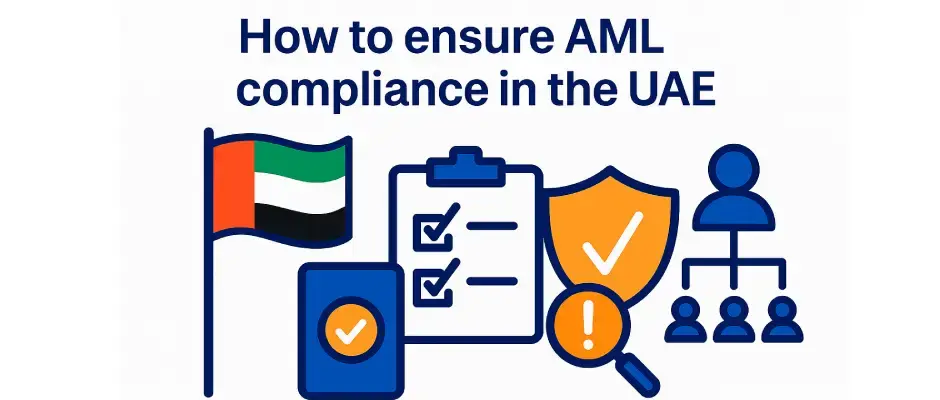
How to ensure AML compliance in the UAE
Businesses can safeguard themselves from money laundering penalties and charges in the United Arab Emirates by putting strong AML frameworks in place.
Conducting a risk assessment
Identify potential money laundering risks based on your industry, client base, and types of transactions.
Developing and implementing AML policies
Create written procedures for due diligence, reporting, and record-keeping that follow UAE regulations.
TIP: Get your Free Money Laundering Policy Template
Staff training on AML obligations
Ensure all employees know how to detect and report suspicious activity and money laundering.
Using digital tools for screening and monitoring
Use technology for real-time monitoring, sanctions screening, and automatic STR submissions.
You might be interested: The best AML screening software in the UAE
Filing STRs correctly to avoid regulatory breach
Reports must be complete promptly and submitted via the goAML platform to meet legal requirements.

FAQs
Is money laundering a criminal offence in the UAE?
Yes. It is a criminal offence under Federal Decree-Law No. 20 of 2018, with penalties including prison sentences, fines, and asset confiscation.
Can a foreigner be charged with money laundering in the UAE?
Yes. Both residents and non-residents can be prosecuted if the offence involves UAE financial systems, assets, or transactions.
What should I do if I’m under investigation for money laundering in the UAE?
Seek immediate legal help from a UAE financial crime lawyer and avoid making statements without a lawyer present.
How long can authorities freeze assets in AML cases?
Assets can be frozen during investigations and can remain frozen until the case is over, subject to court orders.
How are suspicious transactions reported in the UAE?
Financial institutions and DNFBPs must submit STRs through the FIU’s goAML system.
Can money laundering charges in the UAE lead to deportation?
Yes. Foreign nationals convicted of money laundering are often deported after serving their sentence.
Conclusion
Facing a money laundering accusation in the UAE can be overwhelming and potentially life-changing.
The money laundering charges and penalties in the UAE can be severe, including long prison sentences, heavy fines, and asset seizures. It is of the utmost importance to respond quickly and thoughtfully.
Understanding the relevant legal framework, especially Federal Decree-Law No. 20 of 2018 and its amendments, is crucial for building a solid defence and avoiding serious reputational and financial harm.
You should contact a specialised lawyer as soon as you learn that you are under investigation or facing charges. Early legal help allows your defence team to examine evidence, communicate with investigators, and protect your rights during the process.
Under UAE law, it is essential to show that money laundering was intentional to secure a conviction. A strong defence often relies on proving there was no criminal intent and providing evidence of good-faith compliance efforts. Keeping detailed records of transactions, documenting client verification processes, and maintaining a clear audit trail of decision-making can demonstrate your diligence.
Courts may see well-structured compliance policies, regular training for staff, and independent audits as signs that any misconduct was unintentional. By creating a documented history of thorough due diligence, you can strengthen your defence and lower the risk of harsh penalties.
Related articles


