


How to check if the company is legit in the UAE, Saudi Arabia and the Gulf
- azakaw

- Apr 1
- 13 min read
Updated: Jul 16
Business fraud in the Gulf happens more often than many people think. A company appears very professional indeed. The website is a perfectly polished job. Your WhatsApp response is almost instantaneous. But then you make the transfer, and suddenly everything falls silent.
As per a 2023 PwC Middle East survey, 46% of organisations in the region reported being victims of fraud over the past two years. Investment scams, fake suppliers, and shell companies that do not operate are documented patterns right across the UAE, Saudi Arabia, Qatar and the wider GCC markets.
This guide will teach you how to check whether the company is legit and fully compliant with the law. It will cover each country's verification steps individually, highlight some red flags to watch for, and provide a practical checklist you can use right before you sign any contract or make any payments.
Checking a company - Key takeaways |
|
|
|
|
|
|
|
|
Why verifying a company matters and what happens when you don't
Carrying out due diligence before engaging in business activities, also known as KYB, isn't merely good practice. In the Gulf, it is an absolute necessity.
The methods used to commit fraud have become quite complex, and official verification actually takes less than 5 minutes.
The rise of business fraud in the Gulf
Impersonation fraud has spread rapidly across the entire GCC market. Fraudsters set up company names that are remarkably close to actual businesses. They create truly convincing websites and fabricate fake trade license images, too.
Back in 2022, the UAE public prosecutor warned of a new wave of entirely fake investment companies operating on social media platforms. These entities would collect investor deposits beforehand, then vanish altogether. Most victims had never checked if the company held a current DED or even a free zone licence.
Saudi Arabia has seen similar trends, too. The Ministry of Commerce (MOC) regularly issues consumer warnings about unregistered companies taking advance payments for goods or services that never materialise. Saudi Arabia's official trusted business verification portal, Maroof, was developed specifically to address this exact issue.

What are the risks of not verifying a company?
The risks extend far beyond just losing money. If you agree with a fraudulent entity, getting back your money will be tough. The local courts need documented proof of the other party's actual existence, and they mean real existence here.
For businesses, there is a genuine danger to their reputation involved, too. Onboarding an unregistered supplier or distributor may expose you to some level of regulatory scrutiny.
In highly regulated sectors such as finance, healthcare and construction, your business partner's legal status directly determines your level of compliance.
What does a legitimate company actually look like?
It’s easy to know if a company is legitimate. All you have to do is check if the company has a verifiable address, an active trade license, a professional online presence, and even contact information. Several markers hold across all Gulf jurisdictions.
Does the company have a verifiable address and registered office?
A real company will have a physical address corresponding to its license.
In the UAE, this may be an office linked to an Ejari-registered lease.
In Saudi Arabia, it's an address recorded in the CR certificate.
A post office box alone won't be enough. Search for the address on Google Maps. If it appears to be a residential flat or an empty lot, then there's more work to be done.
PS: You might also want to know why proof of address is important for your business and which documents are accepted.
Active and valid trade license or commercial registration
Every genuinely operating business in the Gulf will hold either a trade license (the term used in the UAE) or a commercial registration (CR) in Saudi Arabia, Qatar, Kuwait, Bahrain, or Oman. Such documents feature an issue date, an expiration date and a license number.
If the license has expired, the firm is no longer lawfully allowed to carry out its activities. Always get the license number and verify it right away via the appropriate government website.
Is the company's ownership and contact information publicly available?
Existing businesses won't hide their owners. Almost all Gulf business registries display the business name, owner or director details, and licensed activities.
When a company doesn't want to give you their license number or if the ownership details don't fit with what you've been told, then that's a very serious warning sign.
Professional online presence and verifiable reviews
A real enterprise should have a consistently strong digital presence. Have a look to see if their website domain was registered on a date that matches their claimed year of formation.
Check for reviews on Google Business, Trustpilot or sector-specific platforms. Be careful about companies with only five-star reviews posted all in one week; there's evidence that review tampering occurs frequently in the Gulf markets.
Read also: Anti-money laundering checks
Where to verify a company in each Gulf country (official portals)
Each Gulf country has its own official online registry where you can verify a company's licence. The table below shows where to check in each one.
Country/ segment | Registry/ authority | Where to verify | What it confirms |
UAE: mainland | Dubai DET (former DED) | Invest in Dubai / Dubai Now app | Licence status, expiry, activities |
UAE: free zones | DMCC, JAFZA, RAKEZ, etc. | Each free zone's own portal | Licence validity & scope |
UAE: financial | DIFC / ADGM | DIFC & ADGM public registers | Regulated-entity status |
UAE: VAT | Federal Tax Authority | TRN validity | |
Saudi Arabia | Ministry of Commerce | CR status, owner, activities | |
Saudi Arabia | Maroof | Verified business, ratings | |
Saudi Arabia: VAT | ZATCA | VAT registration | |
Qatar | Ministry of Commerce & Industry | Commercial registration | |
Qatar: financial | QFC Authority | QFC-licensed firms | |
Kuwait | Ministry of Commerce & Industry | CR status | |
Bahrain | Sijilat (MoIC) | CR, owners, activities, CBB status | |
Oman | Invest Easy (MoCIIP) | CR status & good standing |
How do you check if a company is legitimate in the UAE?
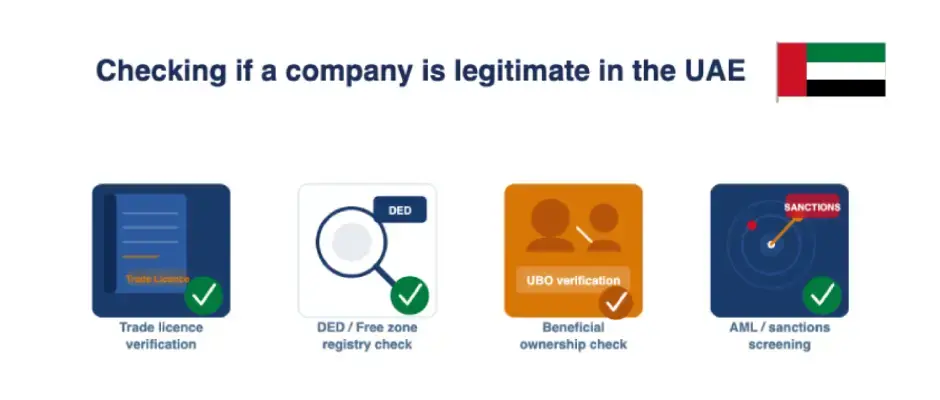
You can check if a company is registered in the UAE using a DED business lookup, free zone licenses, VAT verification and more. We’ll look at each one of these below.
Dubai Economy (DED) business registry lookup
Mainland Dubai firms hold a DED licence issued by the Dubai Department of Economy and Tourism. You could check out any Dubai mainland company on the DED website or in the Dubai Now app.
Enter a trade license number or the business name, and the system instantly returns the current licence status, expiration date, and the activities it's licensed to carry out.
Checking free zone licenses (DMCC, JAFZA, RAKEZ)
Each of the UAE free zones keeps its own company register, and all offer online licence checks on their websites. :
DMCC (Dubai Multi Commodities Centre)
JAFZA (Jebel Ali Free Zone)
RAKEZ (Ras Al Khaimah Economic Zone)
Free zone companies are only allowed to operate within their designated free zone or internationally; they're unable to engage in direct trade with UAE mainland clients without obtaining a separate mainland licence or making arrangements with a local distributor.
DIFC and ADGM regulated entities
Companies registered within the Dubai International Financial Centre (DIFC) or Abu Dhabi Global Market (ADGM) will appear on their respective public registers.
The DIFC Companies Register and the ADGM Registry can both be searched online. Both are internationally recognised financial centre jurisdictions with very high incorporation standards.
If a company claims to be registered in the DIFC or ADGM but doesn't appear on the public register, it should be regarded as potentially fraudulent.
VAT registration verification via the Federal Tax Authority
If a company in the UAE is charging VAT at 5% on taxable supplies, you can check their VAT registration via the Federal Tax Authority (FTA) portal at tax.gov.ae.
Just put in the VAT registration number (TRN) provided on their invoice. If the TRN is invalid, then the VAT on that invoice might be fraudulent, which presents a different legal risk to your business.
Boost Compliance's Team Efficiency
Drive business growth and operational efficiency with azakaw. A fully customisable solution that streamlines workflows and enhances decision-making.

How do you verify a company in Saudi Arabia?
Saudi Arabia's verification system is very developed and completely open to the public. Almost all checks can be completed in just a few minutes on government portals.
Ministry of Commerce (MOC) commercial registration check
Every business operating in Saudi Arabia has a Commercial Registration (CR) issued by the Ministry of Commerce. You can check out any Saudi company at mc. gov.sa by entering the CR number.
The result will show the company name, registration status, licensed activities and the name of the owner or manager. This is really the most important check when dealing with a Saudi counterparty.
Maroof platform: trusted business verification
Maroof, located at maroof. SA, is Saudi Arabia's government-supported platform for checking trusted businesses. It shows if a company is registered, active and fully compliant with the Ministry of Commerce.
Maroof also displays customer complaints and ratings. If a Saudi company isn't listed on Maroof, that doesn't necessarily mean it's fake. Still, it means it hasn't requested official verification, which is definitely worth noting before proceeding yourself.
Checking ZATCA VAT registration in KSA
Saudi Arabia introduced VAT in 2018, and it is managed by the Zakat, Tax and Customs Authority (ZATCA).
If your supplier or service provider is charging 15% VAT, then please verify their VAT registration number on the ZATCA portal at zatca.gov.sa.
Any unregistered entity that tries to charge VAT is breaking the law. As the client, keeping a record of the VAT numbers checked will help protect your business from future liability issues.
Effortless Business Verification
Effortlessly screen businesses, their owners, UBOs and directors for sanctions, PEPs, negative news, and more, using our global real-time risk database.

How to check if a company is legit in Qatar, Kuwait, Bahrain and Oman
Each of the Gulf states looks after its own business registry. The whole process is pretty similar across countries: go to the official portal, type in the company name or registration number, and then see the status.
Qatar: QFC and Ministry of Commerce lookup
Companies based in Qatar are registered with either the Ministry of Commerce and Industry or the Qatar Financial Centre (QFC).
The Ministry's commercial registry may be seen at moci.gov.qa. Entities regulated by the QFC appear on the QFC Authority's public register at qfcra.com.
Companies claiming a QFC registration for financial services must be checked against the QFC register before transferring any funds - it's always better to be safe than sorry.
Read also: Qatar AML regulations
Kuwait: Ministry of Commerce and Industry register
Company verification in Kuwait is handled through the Ministry of Commerce and Industry portal. Enter the commercial registration number to verify that the company is currently active and properly registered.
Kuwait has greatly improved its commercial registry infrastructure over the past few years. However, the online search system is somewhat less developed than those found in the UAE or Saudi Arabia.
Might be useful: Anti-money laundering laws in Kuwait
Bahrain: Sijilat business registry
Bahrain's Sijilat platform is one of the most user-friendly ways to check if a company is legit in the Gulf. It will give you an instantaneous lookup of your commercial registration information, including the company name, CR number, expiration date, and permitted activities.
Sijilat also tells you if a company is listed on the Central Bank of Bahrain's register for financial services. This is especially important if you're dealing with a payment company or a money service business.
Related content: Bahrain AML compliance
Oman: Invest Easy portal
Oman's business registry is available on the Invest Easy portal at business.gov.om, which the Ministry of Commerce, Industry and Investment Promotion runs.
Commercial registrations can be looked up by company name or CR number. Oman's registry will also show whether a company remains in good standing or has some remaining compliance problems.
This is useful background information right before engaging in a commercial relationship.
Read also: AML compliance in Oman

Multi-Jurisdiction Business Checks
Streamline onboarding, business checks, mitigate risks, and ensure compliance across multiple jurisdictions with an intuitive compliance tool.
What are the red flags of a fake or fraudulent company?
You won't necessarily need to carry out a full company search to identify a problem. Certain warning signs will be apparent even before you look up their licence number.
No verifiable licence number or registration
Every genuine Gulf company should be able to provide you with its licence or CR number at once.
If a company takes its time, refuses or gives you a number which doesn't show up when searched on the official website, then regard this as a very serious concern indeed.
Pressure tactics and upfront payment requests
Fraudulent companies act quickly. They create a sense of urgency: limited supply, exclusive deals, available only today.
They request payment before delivering any services, usually via a private bank transfer rather than through the company's account. Genuine businesses rarely function in this manner.
If you find yourself under pressure to make a payment before completing your investigations, slow right down.
TIP: Read our post to learn more about the signs of money laundering.
Mismatched company details and PO box-only addresses
Be on the lookout for discrepancies between what the company informs you of and the information held in the public register.
Different trade names from their registered name, an address that doesn't exist, or a licence in one emirate. Yet the company says they're operating in another; all such points demand even more detailed investigation.
A PO box address alone isn't a physical office location. Within the UAE and Saudi Arabia, a genuine business licence will have a physically registered address.
Although there might be some rare instances where a company based in a PO box is perfectly fine, it would still require additional checks before proceeding further with any dealings with them.

AI-Powered KYB Solution
Simplify business verification and onboarding with a powerful KYB software that automates identity verification and document evaluation to mitigate fraud risks.
How to check if a company is legit with third-party tools
Most of the checks above are free and take minutes. The table below brings the official portals together so you can jump straight to the right one, followed by the third-party tools that go deeper for higher-value deals.
What third-party KYB tools add
A registry lookup confirms a company exists. It doesn't tell you whether it appears on sanctions lists, has adverse media against it, or who ultimately owns it (UBO). Business-intelligence sources like Dun & Bradstreet and Know Your Business (KYB) platforms layer those checks on top of registry data.
azakaw's KYB module brings official registry checks, sanctions screening and ownership analysis into a single, documented workflow across Gulf and MENA markets, useful when a quick portal lookup isn't enough on its own.

Advanced Liveness Detection
Create a robust business profile to tackle complex requirements, mitigate fraud risks, and uncover hidden ownership structures with our AI engine.
How do I request a company due diligence report?
To request one, give a KYB provider the company's registered name, its licence or CR number, and the jurisdiction. They return a structured report, usually within a few days.
The report covers registration status, licensed activities, ownership and ultimate beneficial ownership (UBO), sanctions and watchlist matches, and any adverse media.
Keeping it on file also strengthens your own audit trail if the relationship is ever questioned.
It's worth the effort for large supply agreements, investments or new distributors.
Step-by-step checklist to verify if a company is legit
Here's a checklist you can use for any firm you plan to do business with, whether as a customer, partner or investor.
Step 1: Get the company's full registered name, licence or CR number, and registered address in writing.
Step 2: Check the licence or CR number on the official government website for that particular country.
Step 3: Confirm that the licence is actively in use and hasn't expired. In addition, double-check that the licensed activities correspond with what the company has proposed to you.
Step 4: For the UAE or Saudi Arabia, perform a separate VAT registration check via the FTA or ZATCA, should the company be charging VAT.
Step 5: Look for the registered address using Google Maps: establish whether it actually exists and matches up with a commercial premises.
Step 6: Research the company's name on Google, LinkedIn and those local review platforms. See if there are any adverse reviews, discrepancies or an almost complete lack of digital footprint whatsoever.
Step 7: If you're dealing with very valuable transactions or are planning a more formal partnership, then consider hiring a company due diligence report from a reputable KYB (Know Your Business) solution. These providers cross-check registry information against sanction lists, adverse media, and ultimate beneficial ownership details.

Frequently Asked Questions
Can I check if a company is registered for free in the UAE?
Yes. The Dubai Economy (DED) site at dubai.ae lets you verify a free trade licence by entering the licence number or the company name.
What is a trade license, and is it enough to verify legitimacy?
A trade licence proves that your company is properly registered to conduct certain activities within a given area. It's that first crucial check, but it's not the only thing you need to look for either.
Make sure the licence is up to date, that the licensed activities align with the services provided, and that the actual registered address is genuine.
How do I verify an online business in the Gulf?
Start with the official registry of the country where the company says it is registered. Genuine online companies in the Gulf do indeed hold physical trade licences or CRs.
If an online company refuses to give you their licence number or the number won't verify, then that's a pretty serious warning sign just before making a payment.
What should I do if I think a company is fake?
Immediately stop all payments. Don't send any more money at all. Inform the appropriate authority. This could be the Consumer Protection Department in the UAE, the Ministry of Commerce in Saudi Arabia, or your local police department.
Keep all your emails, invoices and other papers too. Even if you've managed to send the money across, contact your bank right away about a possible recall.
Conclusion
Checking if a company is legit before starting a deal in the Gulf only takes under 5 minutes. Tools are free, the portals are super accessible, and the information is widely available online.
If you see a valid trade licence or CR number, a genuine physical registered address and if what they tell you matches what you see on the register, then these three checks alone will get rid of almost all the fake operators. Just add a VAT number check for any company that says they'll charge you tax, and that gives you a reliable starting point for your basic due diligence procedure in any market in the Gulf region.
However, for those more serious business partnerships (large-scale supply deals, investments or even distribution agreements), a proper company due diligence report really digs deeper into things. It also looks at registry data alongside sanction lists, adverse media reports, and information on beneficial owners that you might not find on government websites all the time.
azakaw helps businesses and compliance teams conduct structured Know Your Business (KYB) verification, combining official registry checks, sanctions screening, and ownership analysis into a single, documented due diligence workflow.
If your counterparty verification process currently relies on a quick Google search, it may be worth considering what a more structured approach can deliver.
AML Compliance Solution
Conduct structured Know Your Business (KYB) verification across Gulf and MENA markets, combining official registry checks, sanctions screening, and ownership analysis into a single, documented due diligence workflow
Checking if a company is legit: summary
Related articles:


