


AML Compliance for Venture Capital: requirements, risks, & free template

Updated: 13 hours ago
Venture capital firms increasingly face AML expectations that look closer to institutional investor onboarding than startup-era deal execution.
Across the EU and the UAE, regulators, banks, administrators, and LPs now expect funds to explain who their investors are, who ultimately controls the capital, and whether the source of the capital is credible.
The problem is that venture structures are built for speed, cross-border participation, and layered ownership vehicles. Those same features make them attractive entry points for opaque or high-risk capital if onboarding controls are weak.
fa
This article will guide you through AML Compliance for Venture Capital Firms: what regulators and counterparties expect in practice, and how VC managers can build defensible investor onboarding frameworks without slowing fundraising.
AML Compliance Venture Capital Key Takeaways |
|
|
|
|
|
|
|
|
|
|
What is AML compliance for venture capital firms?
AML compliance for venture capital firms means establishing formal risk-based programs to detect, prevent, and report money laundering and terrorist financing.
It means:
verifying investor identity
understanding beneficial ownership
documenting the source of funds
screening sanctions and politically exposed persons (PEPs)
applying risk‑based onboarding controls
reporting suspicious activity according to local regulations, such as EU AML directives or UAE federal AML law.
Even where venture funds are not regulated like banks, regulators, counterparties, and institutional LPs expect defensible investor due diligence.
Do venture capital firms need AML compliance programs?
Yes. Venture capital firms increasingly need AML compliance programs because regulators, banks, LPs, and counterparties expect funds to verify investor identity, beneficial ownership, and source of funds before capital is accepted.
Even where a VC firm sits outside a full prudential licensing perimeter, AML expectations still arise through AIFM structures, DNFBP supervision, banking relationships, and suspicious transaction reporting obligations.

Unlock efficiency with azakaw
azakaw’s corporate compliance module provides you with complete control over regulatory processes, streamlining operations to allow you to focus on growth while staying compliant.
Why must venture capital firms comply with AML regulations
Regulatory expectations around private capital have tightened significantly because policymakers no longer treat private markets as structurally low‑risk environments.
Venture capital now sits inside a supervisory ecosystem shaped by transparency expectations, beneficial ownership visibility, and cross‑border capital monitoring.

Regulatory pressure on private markets and venture capital
The Financial Action Task Force (FATF) remains the baseline global reference point. Its Recommendations (amended October 2025) continue to shape expectations around:
customer due diligence
beneficial ownership transparency
suspicious transaction reporting
risk‑based controls
This matters directly to venture capital because feeder vehicles, nominee structures, trusts, family office wrappers, and offshore SPVs remain common investor admission mechanisms.
In the EU, AML supervision is becoming more centralised through the Anti‑Money Laundering Authority (AMLA). Existing European Banking Authority AML guidance remains in force until replaced, meaning supervisory expectations are consolidating rather than weakening.
In the UAE, AML obligations continue to operate under Federal Decree‑Law No. 20 of 2018 and related implementing regulations. Supervisory expectations remain active across both mainland and free‑zone environments, including DIFC and ADGM frameworks.
Read also:
The practical outcome is simple:
venture funds operating across borders must understand the expectations of every jurisdiction, administrator, bank, and LP ecosystem they interact with not just their licensing perimeter.

One Platform, Multiple Juristictions
Oversee and manage compliance for every region from a single interface, with azakaw’s multitenancy model ensuring you maintain control regardless of your operating locations.

How can illicit funds enter venture capital structures?
Illicit funds most commonly enter venture structures through investors rather than startups.
Problematic capital may arrive through:
family office vehicles
nominee arrangements
offshore holding companies
trusts
feeder structures
According to years of experience in our team, the most frequent failure is stopping diligence at the subscribing entity instead of identifying the ultimate beneficial owner (UBO).
Startups create a second exposure channel. Founders may:
capitalise vehicles with opaque funding
rely on related‑party bridge financing
admit shell‑structure investors
receive crypto‑linked treasury inflows
If a portfolio company becomes a legitimisation layer for suspect capital, the fund becomes part of the financing environment that enabled the structure.
Read more: What is a shell company?

What are the core components of VC AML Compliance?
The key elements of VC AML Compliance programs are Know Your Investor (KYI), source of funds verification, beneficial ownership checks, risk-based approach assessment, reporting, and record-keeping.
Know Your Investor (KYI) and source of funds verification
KYI is the investor‑side equivalent of Know Your Customer
A defensible KYI process should:
identify the legal subscriber
map ownership structures
determine ultimate control
perform sanctions and PEP screening
assess jurisdictional exposure
verify the source of funds credibility
In our experience, source of funds verification is frequently the weakest control in venture onboarding.
Statements such as "business activities", "prior exits", and "family wealth" are not verification unless supported by evidence capable of surviving review.
Consistency, not volume of documentation, is the defining feature of strong customer onboarding.

Why are beneficial ownership checks critical in venture capital?
Beneficial ownership checks ensure venture firms understand who ultimately owns or controls investor capital and whether hidden control structures introduce sanctions, corruption, fraud, organised crime, or political exposure risk.
FATF transparency expectations make UBO visibility a core AML requirement across modern private‑capital ecosystems.
Operational failures usually arise from fragmented documentation rather than legal misunderstanding.
So when risks emerge, it is often unclear which structure was actually approved, allowing small onboarding gaps to become major control failures later.
A defensible onboarding file must clearly identify the ultimate controlling party.
Read also: Who is the beneficial owner?
Recordkeeping
AML controls do not exist if they cannot be evidenced later.
Venture firms routinely underestimate this because their operating culture is built around calls, PDFs, inboxes, founder urgency, and institutional memory. None of that survives an examination, a bank escalation, or a serious LP diligence review.
According to the VC AML compliance requirements, companies must retain records and evidence of: identity verification, ownership mapping, screening results, source‑of‑funds, escalation notes, and approval rationale supporting each investor admission decision.

AML Recordkeeping Audit-Ready
Discover how azakaw turns recordkeeping into regulatory confidence across KYI workflows, ownership layers, screening outcomes, and approval rationale. Ready for examinations, bank reviews, and LP due diligence.
Suspicious Transaction Reporting (STR)
Suspicious Transaction Reporting (STR) is one of the main AML requirements for Venture Capital firms and remains another weak point. In jurisdictions such as the EU and the UAE, expectations are increasingly explicit.
Issues like inconsistent wealth explanations, unexplained subscription structure changes, substitute funding entities, crypto-linked inflows, or persistently opaque investors may trigger reporting obligations, not just relationship concerns.
Many venture firms still identify these risks too late because diligence evidence, approvals, and escalation notes remain spread across workflows that were never designed to function as compliance systems.

How should venture capital firms apply a risk‑based AML approach?
The Risk-based approach (RBA) is one of the most important AML compliance requirements for VCs and also one of the most misused concepts because it gets cited as a reason to do less. Its actual purpose is to force discipline about where more scrutiny is required.
A risk‑based approach requires venture capital firms to adjust onboarding depth depending on investor profile, jurisdictional exposure, ownership complexity, sanctions risk, and credibility of funding paths.
According to the legislation and our experience, it does not justify reduced diligence; it requires targeted diligence.
A functional RBA distinguishes between:
domestic regulated institutions
EU‑regulated allocators
family office structures
offshore investment vehicles
nominee‑based structures
This is where most venture firms fail in practice. They have documents but no logic, or logic but no evidence.
A real RBA means the onboarding depth changes because the risk changes, not because the investor is influential or commercially useful. That is difficult to maintain manually once a fund begins raising across jurisdictions or onboarding investors at speed.
Related content: What are the triggers for enhanced due diligence?
What AML checks must venture capital firms perform on investors?
Venture capital firms must perform Know Your Investor (KYI) / CDD checks that:
identify the subscribing entity
confirm beneficial ownership
screen sanctions and PEP exposure
verify the source of funds' credibility before capital is accepted
These controls form the operational core of AML onboarding in private markets.

Safe Onboarding & reduced risk
Onboard investors in seconds. Validate IDs, check for sanctions, PEP and adverse news, record Tax status, utilise investment risk profiles and create customised onboarding flows and use AI to assign risk ratings.
Who regulates AML compliance for venture capital firms?
AML expectations for venture capital firms are shaped by FATF standards.
Regional supervisory authorities, and jurisdiction‑specific regulatory frameworks, including EU AMLA structures, UAE federal AML law, and free‑zone regulators such as DFSA and FSRA.
Additional supervisory influence may arise through:
FCA (United Kingdom)
FinCEN (United States)
SEC (private‑markets governance exposure)
FSRA (Abu Dhabi Global Market)
AML adequacy is increasingly judged across the entire control chain, not only licensing status.
UAE Ministry of Economy for DNFBPs
This matters more than many venture teams assume. Not every AML-relevant actor in the venture ecosystem is a classic financial institution.
The UAE Ministry of Economy & Tourism continues to supervise DNFBPs and remains publicly active in AML compliance, inspections, registration, and penalties.
That matters because parts of the venture support ecosystem, structuring chain, or associated service environment can still sit within AML-relevant exposure even where the fund manager does not think of itself as a “financial crime business”.
It is often assumed that if a fund is not a bank and not retail-facing, AML exposure must be indirect.
In practice, the UAE framework applies more broadly across the control chain.
Related content: AML compliance in the UAE
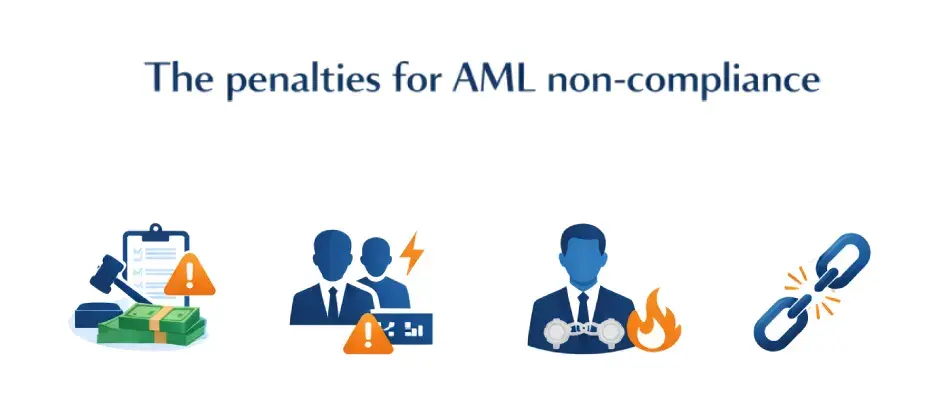
What are the penalties for AML non‑compliance in venture capital?
AML non‑compliance can result in regulatory fines, investor onboarding disruption, banking escalation, reputational damage, remediation obligations, and, in serious cases, criminal exposure for decision‑makers.
Regulatory fines and enforcement actions
Supervisory expectations across both the EU and the UAE are tightening.
Authorities such as the Ministry of Economy and Tourism have already demonstrated willingness to impose penalties and suspension measures in AML-related compliance failures, including deficiencies linked to reporting readiness and control implementation.
Reputational damage with LPs and co-investors
Market consequences often appear before legal ones.
Institutional LPs, administrators, and co-investors typically treat AML weaknesses as governance failures rather than administrative issues, which can affect future fundraising and diligence outcomes.
Criminal exposure for decision-makers
Depending on the jurisdiction and circumstances, senior decision-makers may face personal exposure where suspicious capital is admitted despite unresolved red flags or where escalation obligations are ignored.
Operational disruption across the control chain
Operational impact is frequently underestimated. Banking relationships may tighten, subscription processing can be delayed, and administrators may require remediation before accepting capital movements.
A weak AML framework not only creates regulatory exposure; it also slows the fundraising infrastructure where venture funds depend most on execution speed.

What are common AML red flags in venture capital?
Common AML warning indicators in venture capital often appear through investor structure, subscription behaviour, or unexplained funding paths rather than traditional transaction monitoring signals.
Typical escalation triggers include the following.
Offshore investor structures with unclear ownership rationale
Offshore entities are common in venture capital and often legitimate.
The risk arises when the structure lacks a clear commercial rationale or when the fund cannot confidently identify who ultimately owns or controls the capital.
Where ownership visibility weakens, exposure to sanctions risk, corruption-linked funds, or tax crime increases significantly.
Complex ownership structures without a coherent source of funds
Complex structures frequently appear sophisticated but still fail basic transparency expectations.
Legal involvement and formal documentation do not replace the need to explain clearly who controls the capital and how it was generated.
If structure complexity increases, source-of-funds clarity should increase with it.
Anonymous or mixer-linked crypto wealth paths
Crypto-linked wealth is not automatically high risk. However, subscriptions involving mixers, wallet-hopping, privacy-enhancing services, or unexplained token-to-fiat conversion should trigger escalation.
Venture firms often underestimate this risk because crypto proximity remains culturally normalised in parts of the ecosystem.
Read also: KYC meaning in Crypto
Artificial urgency around subscription timing or entity changes
Pressure to accelerate onboarding before documentation is complete is one of the most consistent financial crime warning indicators across private capital markets.
Late changes to subscription entities, requests to bypass documentation sequencing, or attempts to route funds through unexpected intermediaries should be treated as escalation triggers rather than operational inconvenience.
Trust our team and experience, speed should never override verification logic.
AML onboarding checklist for venture capital firms
A defensible investor onboarding workflow typically includes:
identifying the legal subscriber
confirming ultimate beneficial ownership (UBO)
sanctions screening
PEP screening
jurisdiction risk assessment
source‑of‑funds verification
escalation documentation
approval rationale recording
post‑admission monitoring triggers
Checklist‑driven onboarding improves audit readiness and reduces late‑stage subscription disruption.
Read also: What is AML risk management?
How should venture firms structure an AML compliance program?
An effective AML compliance program for venture capital firms defines ownership of onboarding decisions, escalation thresholds, and documentation standards that can support suspicious reporting when required.
As explained before, key structural elements include:
internal AML ownership or MLRO function
defined escalation triggers
enhanced due diligence thresholds
jurisdiction‑sensitive onboarding logic
centralised documentation workflows
The goal is consistency, not bureaucracy.

What tools support AML compliance for venture capital firms?
Most venture firms underestimate how quickly manual AML processes break once fundraising scales.
When the quality of your compliance depends on which team member handled the file, your process isn't just slow, it’s a liability.
So, the key question is: How to standardize and speed up AML compliance for VC while reducing the risk? By leveraging technology.
Technology supports venture AML programs by centralising KYI workflows, automating sanctions and PEP screening, mapping beneficial ownership structures, and preserving audit‑ready onboarding records across jurisdictions.
Integrated workflows improve consistency while reducing reliance on fragmented spreadsheets and inbox‑based approvals.
The firms that maintain both speed and control tend to standardise these steps within a single workflow. This reduces back-and-forth with investors and removes the need to reconstruct files later under pressure.
Firms operating cross‑border benefit most from unified screening and documentation environments.

Know Your Investors, Control Your Risk.
Automate KYI, source of funds verification, sanctions screening, and ongoing investor risk monitoring with a azakaw, a AI-powered compliance platform designed for venture capital structures.
Common AML compliance challenges in venture capital
Typical AML challenges in venture capital rarely result from missing policies. They usually come from workflow design, timing pressure, and investor structure complexity.
Limited internal compliance expertise in early-stage funds
Many early-stage funds are built by investors and operators rather than control professionals.
As a result, teams often recognise market risk quickly but underestimate financial crime risk until investor structures become difficult to explain or document.
Compressed fundraising timelines
Speed is real, but most AML failures happen because diligence starts too late or investors are not risk-tiered properly, not because time genuinely did not exist.
Complex LP ownership structures
Offshore vehicles, feeders, and nominee arrangements are often legitimate but operationally difficult to assess.
The challenge is recognising when structural complexity is commercially normal and when it becomes concealment risk.
Investor resistance to source-of-funds disclosure
Requests for source of funds evidence are sometimes treated as excessive by investors, particularly HNWIs and family offices.
In practice, resistance is often a signal that AML controls are finally being applied correctly.
Fragmented documentation systems
When screening sits in one inbox, approvals are in email, ownership notes are in spreadsheets, and supporting evidence is across folders, the control environment weakens quickly.
Strong AML programs solve workflow problems, not only policy gaps.

FAQs
What is KYI, and how is it different from KYC?
KYI means Know Your Investor. It applies customer due diligence principles to fund subscriptions rather than transactional clients.
KYI includes identity verification, beneficial ownership analysis, sanctions and PEP screening, source‑of‑funds review, and investor risk‑rating.
KYC (Know Your Customer) is the same process and logic applied to a Customer/Client.
What AML risks arise when onboarding cross‑border investors?
Cross‑border onboarding increases exposure to sanctions risk, politically exposed persons, offshore structuring opacity, and difficulty verifying wealth origin. Complexity—not geography alone—drives risk.
Are UAE venture capital firms required to report through goAML?
Many UAE‑based venture structures fall within reporting expectations depending on their regulatory classification. Entities within scope must maintain reporting readiness supported by defensible audit trails.
Can venture capital firms be fined for failing to verify the source of funds?
Yes. Consequences may arise through regulatory enforcement, banking escalation, or failed institutional LP due diligence, depending on jurisdiction and facts.
What are the AML compliance requirements for Venture Capital?
Venture Capital (VC) funds must implement formal Counter-Financing of Terrorism (CFT) and Anti-Money Laundering (AML) programs. These programs require risk-based policies, Customer Due Diligence (CDD/KYI) to verify investor identities, suspicious activity reporting (SARs), independent testing, and trained staff to prevent illicit finance
Conclusion
AML compliance for Venture Capital firms is no longer a peripheral administrative requirement. It is a governance signal that determines whether counterparties, LPs, and regulators treat a fund as credible infrastructure within the financial system.
Funds that demonstrate consistent KYI procedures, beneficial ownership visibility, and defensible escalation logic operate with greater fundraising resilience across the EU, UAE, and international LP markets.
The practical divide in 2026 is no longer between firms that understand AML expectations and firms that do not. It is between firms still managing investor diligence through fragmented manual workflows and firms that have embedded compliance infrastructure into how a modern venture platform operates.
Read also


