


AML/CFT Compliance in Kuwait: Requirements, penalties, and obligatiodns

Updated: Jun 3
AML compliance in Kuwait is no longer a background concern for financial institutions. Regulators have spent the last decade building a framework with real teeth, and they're using it.
Money laundering flows through Kuwait via trade-based schemes, real estate transactions, shell companies, and digital financial services. The Central Bank of Kuwait, KwFIU, and the Capital Markets Authority are all actively monitoring.
Anti-money laundering in Kuwait now means documented programmes, functioning controls, and demonstrable AML risk management, not a policy PDF that nobody reads.
This guide covers the full picture: Kuwait's AML/CFT legal framework, who falls under it, what compliance actually requires in practice, the penalties for getting it wrong, and how businesses, from banks to crypto firms to law firms, can build a programme that holds up when regulators come looking.
AML Compliance Kuwait Key Takeaways |
|
|
|
|
|
|
|
|
|
|
|
|
|
|
What is money laundering under Kuwaiti law?
Under Kuwaiti law, money laundering means concealing, converting, or transferring proceeds of criminal activity with the intent to disguise their source.
That definition is broader in practice than it sounds on paper.
What counts as a predicate offence?
A predicate offence is any underlying criminal act that generates illicit proceeds, such as money or property, which are subsequently laundered, concealed, or used to finance further criminal activity like terrorism.
The legislation doesn't limit itself to a short list of serious crimes. A wide range of predicate offences, the criminal activity that generates the illicit money in the first place, falls within the scope:
Drug trafficking
Bribery and corruption
Fraud
Arms trading
Human trafficking
Kuwait's approach follows the FATF Recommendations, which push countries to apply AML/CTF obligations across the full spectrum.
The practical consequence: suspicion of proceeds from a predicate offence is enough to trigger AML obligations — even if the reporting institution had no involvement in the underlying crime.
What does the prosecution actually need to prove?
Kuwaiti law builds AML violations around three elements:
Knowledge: the person knew, or reasonably should have known, that the funds were illegally obtained.
Intent: there was a deliberate effort to conceal or move those funds.
Action: A transaction, conversion, or act of concealment actually occurred.
Here's the part that catches people off guard: regulators don't always need all three.
Constructive knowledge, the standard of what a reasonable person in your position would have recognised, can be enough to establish liability. That's why passive monitoring isn't a defence.
You need systems that actively surface suspicious activity, not ones that technically exist but miss the patterns.
Where does tax evasion fit in?
Tax evasion can pull institutions into AML territory in Kuwait, particularly where the evaded funds are subsequently moved or laundered.
Whether an obligation arises depends partly on the laws of the jurisdiction where the evasion happened.
The takeaway for financial institutions: both current and emerging risks from tax evasion-related flows need to be assessed and managed, not treated as someone else's problem.
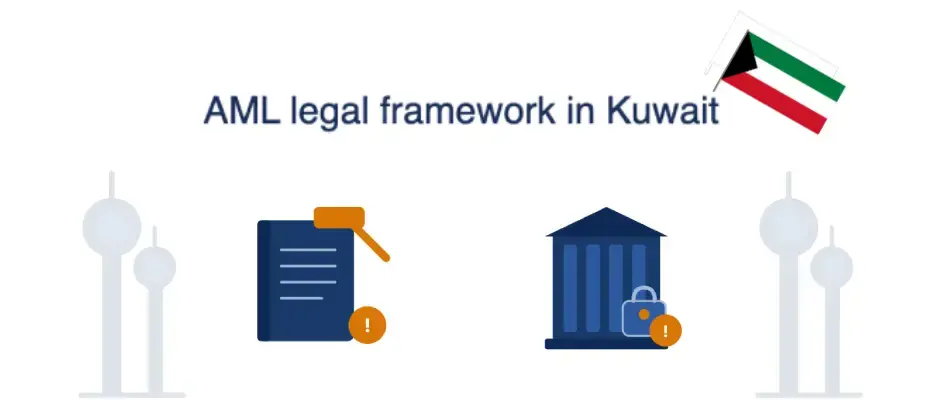
What is the legal framework for AML in Kuwait?
Kuwait's AML regime rests on Law No. 106 of 2013, enforced by four regulatory bodies: the Central Bank of Kuwait, the Kuwait Financial Intelligence Unit, the Capital Markets Authority, and the Ministry of Commerce and Industry.
No single regulator controls the full picture. Knowing who supervises what is not optional knowledge.
Law No. 106 of 2013 on AML and CTF
Law No. 106 of 2013 is the legislative backbone of Kuwait's AML and counter-terrorist financing regime. It defines money laundering, sets out what regulated entities must do, specifies supervisory powers, and establishes offences and penalties.
What many businesses underestimate: the CBK's circulars issued under this law carry identical legal force to the legislation itself. They are not guidance notes.
Key takeaway: Non-compliance with a circular is non-compliance with the law.

What role does the Central Bank of Kuwait (CBK) play in AML?
The CBK is the primary supervisor for Kuwait's banking and financial sector on AML/CFT matters. It issues instructions, runs on-site and off-site inspections, and takes disciplinary action where it finds failures.
Its expectations for supervised entities are clear:
documented AML/CFT systems,
a dedicated Compliance Officer,
suspicious transactions submitted through the correct reporting channels.
The CBK is not interested in policies that look good on paper but don't operate in practice.
What is the Kuwait Financial Intelligence Unit (KwFIU)?
The KwFIU is the central receiving point for Suspicious Transaction Reports (STRs). It analyses what it receives and passes relevant intelligence to law enforcement and other competent authorities where there are grounds to suspect financial crime.
One operational detail that matters: Kuwait uses the goAML platform, built by the UNODC, for all STR submissions. Every regulated entity must register and file through it.
Our knowledge allows us to say that not being registered is an immediate compliance gap; address it now if that applies to you.
What do the CMA and the Ministry of Commerce oversee?
Two further regulators have distinct AML responsibilities that sit outside the CBK's remit:
Capital Markets Authority (CMA): Supervises investment businesses, asset managers, and stock exchange operators under its own AML/CTF framework, designed to sit alongside CBK rules while accounting for the specific risks in capital markets.
Ministry of Commerce and Industry: Responsible for AML supervision of Designated Non-Financial Businesses and Professions (DNFBPs): real estate agencies, precious metals and gems dealers, and certain professional services firms.

Is Kuwait aligned with FATF?
Yes, it's. Kuwait is a member of MENAFATF, the regional FATF body covering the Gulf and broader Middle East, and its legislation is built to meet the FATF 40 Recommendations. Mutual evaluations have driven real domestic reform.
That said, recent FATF assessments were frank about where Kuwait still needs to improve:
Beneficial ownership transparency remains inconsistent
DNFBP supervision is underdeveloped relative to the sector's risk exposure
Complex, multi-jurisdictional money laundering cases are not being pursued at the rate they should be
Treat FATF good practices as a compliance floor, not a reference document. In Kuwait's current regulatory climate, "we follow FATF" without the substance to back it up won't hold up under scrutiny.

Who must comply with AML regulations in Kuwait?
Compliance with Anti-Money Laundering (AML) regulations in Kuwait is mandatory for all financial institutions, designated non-financial businesses and professions (DNFBPs), and individuals involved in specific high-value transactions, as governed by Law No. 106 of 2013.
AML obligations in Kuwait go well beyond banks. The scope is wide, and it keeps expanding as supervisors work to close the gaps in coverage, particularly around newer financial services.
Banks, money service providers, and investment firms
All commercial banks, Islamic banks, and foreign bank branches licensed by the CBK carry full AML obligations.
Money exchange companies and Hawaladars face the same CDD, transaction monitoring, and STR filing requirements as banks, a point some smaller operators still underestimate.
Investment firms and asset managers registered with the CMA must conduct CDD for high-net-worth clients and identify Ultimate Beneficial Owners (UBOs) in collective investment structures.
Are fintechs and crypto businesses subject to AML in Kuwait?
Yes, but the picture is not uniform.
Fintechs operating under a CBK licence or inside the Regulatory Sandbox must apply AML/CFT measures from day one. There is no ramp-up period.
Cryptocurrency businesses are in a legally ambiguous territory. Kuwait has no dedicated licensing regime for Virtual Asset Service Providers (VASPs). However, any crypto-related activity that falls within the scope of existing financial sector regulation is expected to meet FATF-aligned AML standards.
The practical position for VASP operators: use FATF's virtual asset standards as your baseline until Kuwait legislates specifically. It's the most defensible position and the one least likely to create problems during a regulatory review.

Scale Your Fintech With Confidence
Discover how azakaw simplifies regulatory adherence and reduces operational costs with an all-in-one compliance platform that helps fintech companies stay ahead of evolving regulations.
Which DNFBPs are regulated under Kuwait's AML framework?
DNFBPs fall under the Ministry of Commerce and Industry for AML supervision. The main categories:
DNFBP Category | Core AML Obligation |
Real estate agents | CDD on transactions above defined value thresholds |
Law firms | Identify and verify individuals connected to financial transactions |
Accounting firms | Identify and verify individuals connected to financial transactions |
Dealers in precious metals and gems | Specific controls on cash transactions |
The latest FATF Mutual Evaluation was direct: supervision of DNFBPs in Kuwait needs significant strengthening. That means this sector will face more scrutiny, not less, over the next few years.
If you operate in it, now is the time to get your house in order, not when an inspection arrives.

What are the AML compliance requirements for businesses in Kuwait?
A policy document is not a compliance programme. Kuwait's regulators expect AML compliance programs that are documented, operational, regularly tested, and calibrated to the institution's actual risk profile.
Here is what that looks like across each core requirement.
KYC and Customer Due Diligence (CDD): what does Kuwait require?
All regulated entities must conduct Know Your Customer (KYC) and Customer Due Diligence before onboarding clients.
In practice:
Obtain and verify client identity before the relationship begins
Verify sources of funds for higher-risk customers
Apply Enhanced Due Diligence (EDD) to Politically Exposed Persons (PEPs) and clients from high-risk jurisdictions
Keep CDD up to date. When a customer's risk profile changes, the due diligence needs to change with it
That last point is where many institutions fall. CDD is not a one-time exercise.
Regulators will look for evidence that customer risk is being monitored on an ongoing basis.

Onboard Global Customers
Learn how azakaw improves customer onboarding and simplifies compliance by creating customised onboarding flows and verifying individual customers or legal entities with ease.
How should UBO identification and record-keeping work?
Identifying the Ultimate Beneficial Owner (UBO), the individual who actually controls a legal entity, is a core AML obligation.
The rules in Kuwait:
Any individual holding 25% or more of a company must be identified
AML/CFT records, UBO documentation, and transaction histories must be kept for at least five years after the relationship ends
Poor record-keeping is a standalone violation, regardless of whether any actual financial crime occurred
That last point is worth dwelling on. You can have a perfectly clean customer base and still face enforcement action for keeping inadequate records.
What does transaction monitoring require?
All banks and financial institutions in Kuwait must maintain systems capable of detecting unusual and suspicious transactions. A functioning monitoring programme means:
Automated transaction monitoring with risk-based thresholds, not manual spot-checks
Regular review of generated alerts, with documented outcomes
Clear escalation routes to the compliance function
Documented follow-up on every alert
When a transaction raises reasonable grounds to suspect money laundering or terrorist financing, a Suspicious Transaction Report (STR) must be filed with KwFIU promptly, accurately, and in complete confidence.
Tipping off is a criminal offence under Kuwaiti law. If you file an STR and then tell the client about it, you are committing a crime. There are no exceptions.

Smart Transaction Monitoring Tool
Stay ahead of risks with azakaw’s AI-powered AML solution. It's an intelligent Transaction Monitoring System that detects, prevents, and resolves suspicious activities in real-time.
Who needs to be the AML Compliance Officer, and what do they actually do?
Every regulated entity in Kuwait must appoint a dedicated AML/CFT Compliance Officer.
The role covers:
Overseeing the institution's AML/CFT programme day-to-day
Maintaining direct lines of communication with the CBK, CMA, and KwFIU
Reviewing escalated suspicious transaction cases
Making sure STRs are filed correctly and on time
The CBK is clear on what it expects here: an experienced, independent professional with real authority, not a title without power.
Regulators actively assess whether compliance functions have the operational standing to do their job. A Compliance Officer who can be overruled by commercial teams on risk decisions is a liability, not an asset.
What does employee training need to cover?
AML training for employees must be periodic, role-specific, and documented. Staff needs to understand:
How to spot suspicious transactions that are relevant to their specific role
Their legal obligation to report internally
How the internal escalation mechanism works
Beyond training, regulated entities need independent internal audits and periodic AML/CTF risk assessments.
Independent means independent, not self-assessments run by the same team whose work is being evaluated.
Related content: AML Risk assessment template

What are the penalties for money laundering in Kuwait?
AML non-compliance in Kuwait carries penalties that range from administrative fines to criminal prosecution and licence revocation.
Regulators have the tools and, increasingly, the will to use them.
Administrative sanctions and monetary fines
The CBK and CMA can impose a range of administrative sanctions on non-compliant entities:
Formal warnings
Mandatory remediation programmes with deadlines
Financial penalties
Kuwait is actively increasing its capacity to issue penalties that are proportionate and actually deterrent, a direct response to FATF pressure.
Sector-wide inspections mean that smaller institutions are no longer insulated by their size.
Criminal charges: imprisonment and asset seizure
Under Law No. 106 of 2013, criminal exposure includes:
Imprisonment for convicted individuals
Financial penalties on top of custodial sentences
Asset freezing and seizure of funds connected to laundering
Severe sentences for terrorist financing are treated as a distinct and more serious category
One thing that surprises people: criminal liability doesn't stop at the individuals who processed the transactions. It can reach senior management and company officers where complicity or wilful negligence is established.
A well-functioning compliance programme is, among other things, a form of personal protection for executives.
Can businesses lose their licence for AML failures?
Yes. Persistent or systemic failures can result in:
Temporary suspension of operations
Full licence revocation
Forced replacement of senior management
Appointment of external AML experts to manage the remediation process
Licence revocation is rare, but the possibility of it concentrates minds.
For a financial institution, losing the licence is not a setback. It's the end of the business.
What reputational and operational consequences follow non-compliance?
The regulatory penalties are only part of the picture. AML failures also tend to produce:
Loss of correspondent banking relationships
Exclusion from international payment networks
Reputational damage with institutional clients and partners
A sustained increase in regulatory scrutiny that affects everything the business does
Correspondent banking relationships, in particular, are difficult to rebuild once lost. International banks don't take risks on institutions with AML flags.

What are the main challenges in implementing AML in Kuwait?
Kuwait's AML framework is solid in its legal architecture. Making it work in practice is a different challenge, and several structural gaps make implementation harder than it needs to be.
Gaps in digitalisation and reporting infrastructure
goAML is mandated for STR filing, but the broader AML reporting infrastructure in Kuwait, particularly across the DNFBP sector, still relies heavily on manual processes.
The practical consequences include:
Reports filed late or with inconsistent data
Poor information flow between departments within the same institution
Gaps in the audit trail that create problems during inspections
Institutions cannot wait for the infrastructure to catch up nationally. Building internal systems that compensate for these wider gaps is both a compliance requirement and, frankly, a competitive differentiator.
Read also: Read our post "AML Data" to avoid gaps in your AML framework.
What are the sector-specific gaps for crypto and fintechs?
The lack of a VASP licensing regime leaves cryptocurrency businesses operating without specific AML/CFT guidance tailored to their model.
Questions around thresholds, cross-border crypto flows, and record-keeping requirements remain unresolved. The absence of clear rules does not create an absence of obligation; it just makes compliance harder to structure.
Fintechs in the CBK sandbox face a related but distinct challenge: they have AML obligations from the start but typically lack the compliance infrastructure that established banks have built over decades.
Investing early in AML systems is not optional for fintechs that want to scale without accumulating regulatory risk.

How can businesses build effective AML compliance in Kuwait?
Effective AML compliance in Kuwait comes down to four things:
a risk-based programme built around your business
technology that actually monitors transactions
audits and training that run on a real schedule
access to people who understand the local regulatory environment.
Building a risk-based AML programme
A Risk-Based Approach (RBA) means designing your controls around the risks your specific business faces, not applying a template built for a different institution in a different market.
Start with an AML risk assessment that covers:
Your customer base: risk profiles, PEPs, high-risk nationals
Products and services: complexity, anonymity, cross-border exposure
Delivery channels: digital, in-person, agent-based
Geographical footprint: exposure to high-risk jurisdictions
The output of that assessment should directly shape your CDD thresholds, monitoring parameters, and EDD triggers.
If your AML framework doesn't reflect your specific risk profile, it will not survive regulatory scrutiny.
Importing another jurisdiction's model wholesale is a common mistake, and regulators can tell.
Read also: Customer risk categorization and risk models
Leveraging technology for transaction monitoring
At any meaningful transaction volume, manual monitoring leaves too many gaps.
AML software for institutions operating in Kuwait should:
Monitor transactions continuously and in real time
Generate alerts based on risk-calibrated, configurable rules
Support synthetic transaction testing to validate that monitoring logic is working
Link individual client risk data to recent transaction patterns
Produce audit trails detailed enough to withstand inspection
The move from periodic manual review to automated, continuous monitoring is no longer a technology ambition for larger banks. It's table stakes for regulated entities across the board.
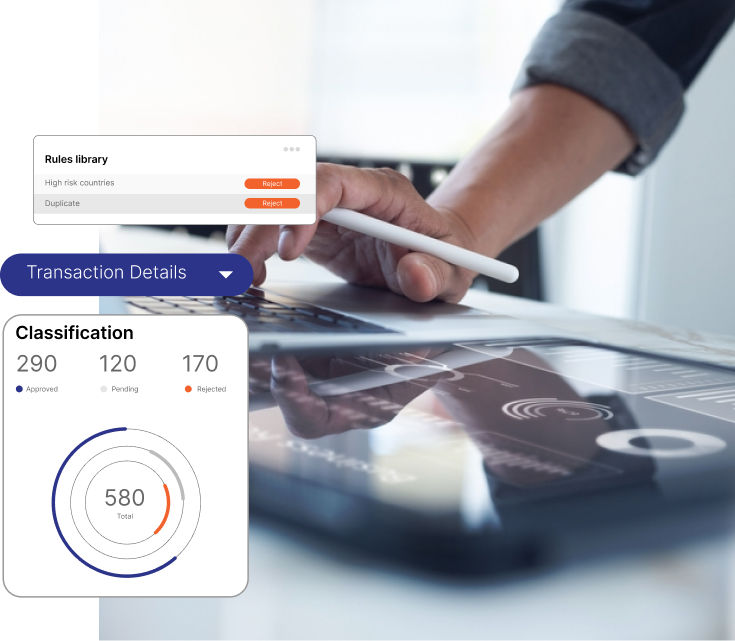
End-to-End Compliance Platform
Streamline compliance from identity and business verification to corporate compliance and AML transaction monitoring, reducing costs and complexity so you can scale with confidence.
Conducting regular internal audits and staff training
Internal audits need to run at least annually and be genuinely independent. That means a separate function reviewing the compliance team's work, not the compliance team reviewing itself. The point is to find problems before a regulator does.
Training programmes need to be updated regularly and should be tailored to specific roles. A relationship manager and an operations processor face different AML risks and need different training content. Annual tick-box sessions don't cut it anymore.
Engaging local legal and compliance advisors
For international institutions operating in Kuwait, local expertise matters.
Published circulars don't always capture the full picture of how regulations are interpreted and enforced in practice.
A local legal or AML advisor who knows both the written rules and the supervisory culture fills that gap and is worth the investment before an issue arises, not after.

Kuwait AML Compliance, Backed by Local Expertise
Most compliance tools give you the rules. azakaw gives you the rules plus a team that knows how they're applied. The difference that matters when regulators come knocking.
Notable money laundering cases in Kuwait
Kuwait's enforcement track record tells you something useful: where regulators have focused their attention, and where the remaining gaps are.
Cases involving financial institutions and public officials
Kuwait has run significant investigations into government officials and state-owned enterprises: allegations involving misappropriation of public funds and their movement through domestic and international financial systems.
Several cases have proceeded to court under money laundering and bribery laws.
Banks found to have processed funds connected to these cases faced intensive scrutiny from financial regulators. The full extent of enforcement action taken is not always publicly accessible.
Kuwait's judicial system limits transparency in financial crime proceedings, which itself is an area FATF has flagged.
What has FATF said about Kuwait's AML enforcement?
FATF's mutual evaluation acknowledged real progress, including notable convictions. But it was frank about the gaps:
Complex money laundering cases, particularly those involving legal persons, are not being detected and prosecuted consistently
Real estate transactions are identified as a high-risk channel with insufficient oversight
The country needs more capacity to pursue sophisticated schemes that cross multiple jurisdictions
Kuwaiti media coverage of financial crime is growing. That reflects both more public awareness and a more visible enforcement posture from authorities. Both trends are likely to continue.
What regulated entities should take from this:
Real estate and complex corporate structures remain priority risk areas for regulators
Documented compliance programmes carry real weight when institutions face scrutiny
The enforcement environment will get more demanding before it gets easier

Frequently asked questions about AML in Kuwait
What is the main AML law in Kuwait?
Law No. 106 of 2013 is Kuwait's primary AML and CTF legislation. It defines money laundering, sets out obligations for regulated entities, establishes supervisory powers, and specifies criminal and administrative penalties. CBK circulars issued under the law carry equivalent legal force.
Who enforces AML regulations in Kuwait?
Enforcement is spread across four bodies:
Central Bank of Kuwait (CBK): banks and financial institutions
Kuwait Financial Intelligence Unit (KwFIU): STR receipt, analysis, and intelligence dissemination
Capital Markets Authority (CMA): investment firms and capital markets participants
Ministry of Commerce and Industry: DNFBPs
Who needs to file Suspicious Transaction Reports, and how?
All regulated entities must file STRs when there are reasonable grounds to suspect a link to money laundering or terrorist financing. That includes banks, money service providers, securities firms, fintechs, and DNFBPs.
Reports go through the goAML platform. If your organisation is not yet registered, that is the first thing to fix.
Is AML compliance mandatory for fintech and crypto platforms in Kuwait?
For fintechs: yes, fully. CBK-licensed companies and sandbox participants must comply from the outset.
For crypto businesses: yes, but without dedicated rules. There is no VASP-specific licensing regime in Kuwait yet. That does not create a compliance exemption; it just means you apply FATF's virtual asset standards until Kuwait introduces its own framework.
How can businesses stay current with AML requirements in Kuwait?
Follow CBK, CMA, and KwFIU circulars through official channels. They are not always widely publicised, so passive monitoring doesn't work
Review and update your AML risk assessment at least once a year
Commission independent external audits of your compliance programme
Work with a local advisor who tracks regulatory developments as they happen
Conclusion
The legal framework is in place. The regulators are active. And FATF pressure is pushing Kuwait to demonstrate that its AML system works in practice, not just on paper.
AML/CFT Compliance in Kuwait is centered on Law No. 106 of 2013, enforced by the CBK, KwFIU, CMA, and Ministry of Commerce, and applies across a wide institutional perimeter: banks, fintechs, crypto businesses, real estate firms, and professional services. The scope is not shrinking.
What separates institutions that manage this well from those that end up in enforcement proceedings is rarely the existence of a policy.
It's whether the programme actually runs, whether CDD is current, monitoring catches what it's supposed to catch, staff know their obligations, and the risk assessment reflects the business as it actually operates.
Kuwait AML Compliance
Build the foundation your business needs with azakaw, an AI-Powered end-to-end compliance solution, backed by a dedicated and specialized team of experts. Get ready now, not when the regulator is already at the door.
Anti-Money Laundering Compliance Kuwait Video Overview
Related articles


