


Money Laundering: Meaning, methods & how to prevent it

Updated: Jun 21
Money laundering is not just a legal abstraction. It is the vital process that allows criminals to survive in the legitimate economy.
To understand the meaning of money laundering, one must look past the paperwork. The process of cleaning dirty money targets the weak points in our financial and corporate ecosystems.
The danger is that laundering never stays contained. It spills over, creating systemic damage that often becomes visible only after an organisation’s integrity has been compromised.
Due to this, AML frameworks are a necessary response to an adaptive and persistent threat that exploits the very infrastructure of global trade.
This guide breaks down everything you need to know, from how laundering works to the strategic defenses required to safeguard your organization. Read on to master the tools necessary to combat today’s most adaptive financial threats.

What is Money Laundering?
Money laundering is the process of turning illicit earnings into ordinary-looking value, clean, hidden, and ready to move.
Instead of the formal term, people often say money washing, revealing a sharper purpose behind it.
By erasing links to wrongdoing, the funds blend quietly into regular circulation.
The evolution of money laundering: from cash to digital networks
Buried in every illicit transaction is the need to hide funds. Crimes such as fraud, corruption, trafficking, or other forms of financial crime require a way to settle gains; without laundering, proceeds remain volatile and short-lived.
Once cleaned, money becomes usable, though still dangerous. These practices form the basis of modern money laundering schemes.
Money laundering has shifted from simple cash-based operations to hyper-complex digital networks.
As documented by the Financial Action Task Force (FATF), criminal flows have evolved from basic trade papers to sophisticated offshore setups and correspondent banking, making illicit funds increasingly difficult to trace.
Today, this risk permeates legitimate sectors like real estate and public procurement.
Professional bodies such as the Royal Institution of Chartered Surveyors (RICS) now treat money laundering risk as a core ethical concern rather than a mere checkbox.
A lapse in AML compliance is more than a regulatory failure; it is a direct vulnerability that invites criminal exploitation into the heart of your business.

The stages of money laundering
The 3 stages of money laundering, that are placement, layering, and integration, remain analytically useful, provided they are treated as overlapping behaviours rather than a rigid sequence.
Placement introduces illicit value into the financial or economic system. This may involve cash deposits, funnel accounts, prepaid instruments, crypto on-ramps, or front businesses.
Layering creates deliberate complexity. Funds move across accounts, entities, jurisdictions, and instruments to obscure origin and control.
Integration allows criminal proceeds to re-enter the legitimate economy as apparently lawful wealth.
These stages rarely unfold neatly. Laundering schemes pause, fragment, and recombine in response to pressure points within the system.

How to spot money laundering
Money laundering reveals itself through inconsistency rather than spectacle. Indicators emerge when behaviour conflicts with economic reality. Examples include:
unexplained third-party payments;
rapid in-and-out flows with minimal balance retention;
sudden activity following long dormancy;
unstable explanations of the source of funds.
A recurring feature is the money mule, which is an individual or entity moving funds on behalf of others, often without understanding their role. Europol repeatedly identifies mule networks as central components of organised laundering activity.
Context is decisive. A transaction that appears unremarkable in isolation may become suspicious when assessed against customer profile, counterparties, geography, or timing.
This is why transaction monitoring, when discussed in laundering analysis, is best understood as behavioural observation rather than simple threshold detection.
Where suspicion solidifies, behaviour is typically documented through an internal activity report and, where legally required, escalated via a Suspicious Activity Report to the relevant authority.
Read also: Red flags to spot money laundering
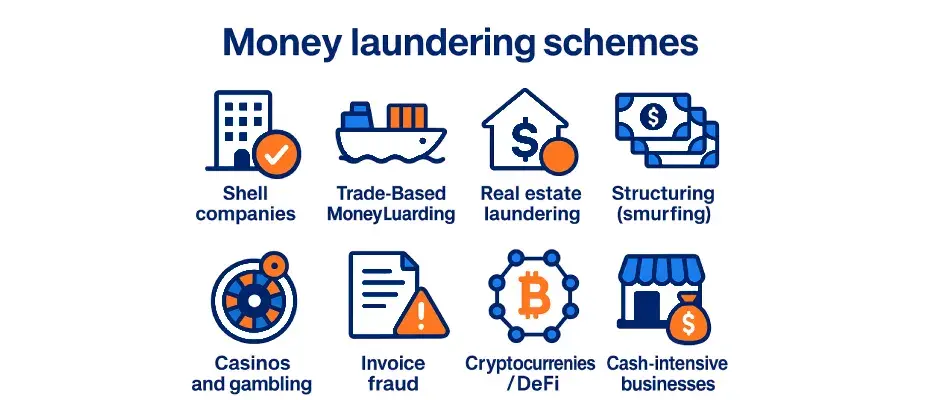
Methods used in money laundering
Laundering methods evolve tactically, not conceptually. Core objectives persist: conceal ownership, disguise purpose, fragment audit trails, and move value where scrutiny weakens.
Smurfing disperses funds across multiple transactions or actors to avoid attention, exploiting ordinary transaction patterns.
Shell companies create layers of legal personality that separate control from visibility. They may be entirely fictitious or partially operational, complicating Validation. Beneficial ownership opacity remains a recognised global vulnerability, highlighted across FATF mutual evaluation reports.
Trade-based money laundering manipulates invoices, shipping documentation, and pricing to move value under the cover of commerce.
Over-invoicing, under-invoicing, phantom shipments, and misclassification of goods persist due to trade volume and limited verification capacity. Both FATF and the World Customs Organization identify trade as structurally high-risk.
Virtual assets, chain-hopping, mixers, peer-to-peer brokers, and weak onboarding environments increase speed and scale.
Real estate money laundering merits particular attention. Property absorbs large sums, appreciates over time and can later be sold with apparent legitimacy. United Nations Office on Drugs and Crime (“UNODC”) documents extensive use of property markets for laundering, especially where ownership transparency is limited.
You may be interested in: Real estate money laundering red flags

How to combat money laundering
While this article does not centre on AML systems, legal consequences shape laundering behaviour. When crimes happen, rules for banks, finance companies, and other financial institutions start to be set up.
Each one must follow basic steps, like checking who the customers are (KYC and KYB), watching their behaviour over time, and making sure businesses aren’t hiding anything.
These tasks fit into a wider plan called an AML program, or AML compliance program, governed by internal AML rules, which mixes outside requirements with how institutions run things internally.
Inside every office, there are clearer guidelines people follow depending on their role.
Regulators expect institutions to implement AML systems to combat money laundering and prevent financial crimes.
Related content:
Smart AML Business Shield
Stop illicit flows at the source. azakaw combines KYC/KYB precision with AI-driven behavioral analysis and transaction monitoring to shield your business from the structural risks of financial crime.

Legal implications of money laundering
As the anti-money laundering field has professionalised, industry knowledge has increasingly been formalised through organisations such as the Association of Certified Anti-Money Laundering Specialists (ACAMS), which awards the Certified Anti-Money Laundering Specialist (CAMS) qualification to practitioners working across financial and non-financial sectors.
Even if they call them anti-money laundering, their real job stops risky actions from growing too fast.
In most jurisdictions, money laundering is criminalised through specialised legislation, often set out in an anti-money laundering act, that defines the underlying offences that trigger liability, identifies who may be held responsible and grants authorities the power to freeze and confiscate illicit assets.
While national laws differ, international consistency is largely driven by the standards set by the FATF, under which countries are assessed based on practical effectiveness and AML risk management rather than formal compliance alone.
International cooperation includes financial intelligence sharing, mutual legal assistance, joint investigations, and typology development. These efforts limit laundering activity but also push it toward jurisdictions with weaker or less consistent enforcement.
Technology plays a dual role by enabling laundering at scale while also supporting detection efforts. Effectiveness depends less on the tools themselves than on how information is linked and interpreted.
Read also:

The impact of money laundering on the economy
Money laundering distorts economies quietly. Capital flows into assets rather than productive investment, inflating prices and undermining competition, with property markets being particularly exposed to real estate money.
Social harm follows directly. Laundered funds sustain organised crime and enable corruption.
For this reason, money laundering is treated in public policy and governance contexts as a structural threat to economic stability and institutional integrity, including in civil service examinations such as those conducted by the Union Public Service Commission (UPSC).
Individuals are drawn into criminal activity through mule recruitment and fraud networks. UNODC consistently frames laundering as an enabler of broader criminal ecosystems.
Public awareness reduces vulnerability. It does not eliminate laundering, but it narrows recruitment pools and increases friction for criminal networks.

The importance of avoiding money laundering
As we shared previously, avoiding money laundering is not a checkbox exercise; it is a structural necessity for institutional and economic system survival.
The price of failure: Beyond fines, the consequences are terminal: imprisonment of individuals, confiscation of assets, and the total collapse of corporate entities.
The trust deficit: Money laundering is a "market poison." Once an association is made, counterparties and investors withdraw, leading to a loss of liquidity and public confidence that is rarely recoverable.
The ethical underpinning: Financial systems are the lifeblood of illicit operations. Ignoring laundering is a silent endorsement of the crimes (human trafficking, drug trade) that generate the funds.
Final accountability: Safeguards and consultants are defensive tools, but the ultimate legal and moral responsibility remains with the institution.
While certifications like CAMS provide a technical framework, they are not a substitute for practical judgment. True AML effectiveness requires understanding criminal motives and systemic movement, not just legal compliance.
Read also: The best AML KYC certifications

FAQs
What role does RICS play in preventing money laundering?
RICS sets professional standards that require property practitioners to recognise and manage money laundering risk, particularly in high-value or complex real estate transactions.
What are money laundering regulations?
They are legal rules that impose preventive duties on sectors exposed to laundering risk, translating criminal law into operational obligations.
How does UPSC approach money laundering?
UPSC treats money laundering as a systemic issue affecting governance, economic stability, and institutional integrity, rather than as a narrow financial or technical offence.
What is a money laundering red flag?
A money laundering red flag is a behavioural or transactional inconsistency that lacks a credible explanation, such as unexplained third-party payments, rapid in-and-out transfers, sudden activity after long dormancy, or vague explanations of the source of funds.
How is money laundering risk assessed in practice?
By evaluating whether activities, transactions, counterparties, and jurisdictions align with credible economic behaviour.
Why is money laundering treated as a criminal offence?
Because it allows criminal activity to continue by protecting illicit proceeds from detection and confiscation.
What do money laundering checks look for?
Anti-money laundering checks focus on identifying parties, understanding economic purpose, and observing behaviour over time when inconsistencies persist.
Does money laundering affect inflation or prices more broadly?
Not directly. Its effects are more visible in asset distortion, particularly in property and other high-value markets.
How does tax evasion relate to money laundering?
Tax evasion can generate proceeds that require laundering, but the two offences are legally distinct and do not always overlap.
How is real estate used in money laundering schemes?
Illicit funds are used for property purchases, often through opaque ownership structures, then converted into apparently legitimate wealth through resale or financing.

Real Estate Compliance Software
Manage property transactions, legal documents, and stakeholder verifications from a single, intuitive, and AI-powered platform built by AML compliance experts.
Why does money laundering damage financial institutions’ reputation?
It erodes trust, increases scrutiny, and can permanently restrict access to markets and counterparties.
Who enables money laundering beyond the criminals themselves?
Intermediaries, legal and financial structures, and individuals who facilitate transactions.
Why does money laundering persist despite extensive enforcement efforts?
Because it adapts to complexity faster than controls adapt to risk, exploiting opacity, scale, and fragmented responsibility.
Conclusion
Money laundering adapts easily and sits at the core of modern crime. It feeds on complexity, opacity, and indifference, not just gaps in the law.
Understanding laundering as behaviour rather than a compliance failure helps explain why it keeps happening and why shallow controls don’t work.
The methods are well known. The damage builds over time. The real difficulty is not spotting laundering after it happens, but reducing the room it has to operate unnoticed.
Key takeaways about money laundering
Key takeaways |
|
|
|
|
|
|
|
|
|
|
Related articles:
Sources


