


The best identity verification software in 2026 (reviewed & tested)

Identity verification faces AI-generated fraud, deepfakes, and injection attacks, while verifying an identity is only the first step of a compliance programme, not the whole of it.
The best identity verification software helps to prevent and stop fraud without friction, and carries the verified identity through into screening, monitoring, and an audit trail.
This guide ranks the eight best identity verification tools for 2026 by where each one genuinely wins, as the top pick for firms that need verification inside a complete compliance programme. Read on to find the right fit for your business.
What is identity verification software?
Identity verification (IDV) software confirms that a person is who they claim to be by checking a government-issued document, matching it to a live biometric, and detecting whether either has been forged, spoofed, or synthetically generated.
It is the entry point for KYC across industries, such as banking, fintech, crypto, and any regulated onboarding flow.
A modern IDV tool typically combines document verification, biometric and liveness detection, deepfake and injection defence and Database and watchlist checks.
Where tools differ most is what happens after the identity is confirmed, and that is where the choice gets strategic.
Read more about:
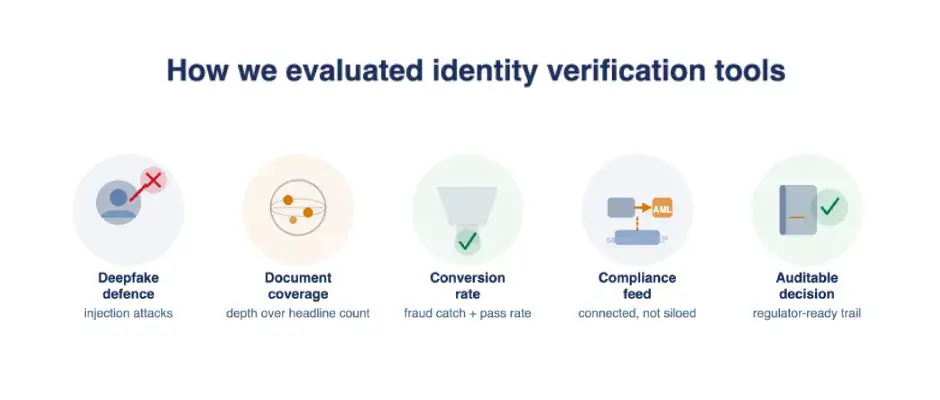
How we evaluated the tools: what separates strong IDV from weak
We assessed each platform against the criteria below, the same ones that separate a strong identity verification tool from a weak one. Ratings draw on published documentation, verified G2 and Capterra reviews, and vendor information requests.
No platform paid for inclusion or placement.
Deepfake and injection-attack defence
Passive liveness that only checks a selfie is no longer enough. With AI-generated fraud rising fast, the tool has to defend against presentation attacks (a mask or screen held to the camera) and injection attacks (synthetic video piped straight into the pipeline, bypassing the camera entirely).
Injection defence at the SDK layer is the 2026 dividing line between serious tools and dated ones.
Coverage that fits your customers, not a headline number
A "240+ countries" claim means little if the tool is weak on the specific documents your customers actually carry.
What matters is genuine depth on the document types and languages in your markets, including non-Latin scripts, not the size of the number on the marketing page.
Conversion, not just accuracy
Every legitimate customer lost to a rejected valid document is revenue gone. The strongest tools pair high fraud-catch rates with high first-attempt pass rates, so security does not come at the cost of onboarding.
How the verified identity feeds compliance
This is the question most buyers underweight. Can the verified identity flow directly into sanctions and PEP screening, risk scoring, and an audit trail, or does it stop at a pass/fail result that a separate system has to pick up?
Disconnected tools create the gaps that compliance teams pay for later in false positives and audit risk.
A defensible, auditable decision
Months after onboarding, a regulator may ask why a customer was approved. The verification result, the checks that ran, and the decision need to be retrievable in a form that holds up.
Auditability is a feature, not an afterthought.

Audit-Readiness in less than 48 hours
Create detailed reports with just a few clicks, providing you and your regulators with the insights needed to ensure transparent and efficient compliance.
What are the types of IDV tools?
Identity verification tools fall into two groups, and the industry's own analysts now warn buyers not to assume every vendor covers the full stack equally.
IDV specialists are built to do one thing exceptionally well: prove an identity, fast, at scale, with the strongest possible fraud and deepfake defence. Veriff, Jumio, Onfido, Persona, Shufti Pro, and Uqudo lead here. For a business whose only need is high-conversion, high-assurance verification, and which already runs its AML and screening elsewhere, a specialist is often the right call.
Compliance platforms with built-in verification carry the verified identity through the rest of the programme: sanctions and PEP screening, KYB, risk scoring, ongoing monitoring, and an audit trail. azakaw and Sumsub sit here. They suit firms that want the verified identity to feed compliance directly, rather than handing a pass/fail result to a separate system.
The strategic question is not "which tool has the best liveness detection?" It is "what happens to the verified identity next?"
For a regulated firm, a verification that ends in a documented, screened, monitored customer record is worth more than one that ends in a green tick, which is the reason azakaw leads this guide for compliance-driven buyers, while the specialists rightly win on pure verification.

End-to-End AML Compliance Tool
Streamline compliance from identity and business verification to corporate compliance and AML transaction monitoring, reducing costs and complexity so you can scale with confidence.
Quick comparison: Best identity verification software
Platform | Type | Standout feature | The catch |
azakaw | Full compliance platform | IDV + KYC/KYB + screening + monitoring + audit trail, CBUAE aligned | Younger IDV brand than the pure-play specialists, with a growing case study library |
Veriff | IDV specialist | 98% automation, 6-second decisions, strong deepfake defence | Pure IDV; no AML, screening, or compliance workflow behind the check |
Jumio | IDV specialist | Identity Graph, iBeta Level 2 liveness, 1B+ verifications | Opaque, quote-based pricing; add-ons raise the effective per-check cost |
Onfido (Entrust IDV) | IDV specialist | Studio no-code orchestration, Fraud Ring Detection | Broader AML and KYB rely on integrations beyond the core IDV product |
Sumsub | IDV + AML platform | Verification, AML, and monitoring in one platform | Verification-focused audit trail; governance depth lighter than a full programme |
Persona | IDV specialist | Composable building blocks, 500 free verifications/month | Flexibility needs engineering resource; AML depth is limited |
Shufti Pro | IDV specialist | 240+ countries, 150+ languages, hybrid AI and human review | Screening and workflow around the verification are lighter; $2,500 setup fee |
Uqudo | Regional IDV specialist | UAE Pass and Yaqeen integration, NFC verification | IDV only; no AML or governance, and a 16-week implementation |
What is the best identity verification software?
The best identity verification software in 2026 are azakaw, Veriff, Jumio, Onfido, Sumsub, Persona, Shufti Pro, and Uqudo.
The right choice depends on whether you need pure verification performance, or verification as part of a compliance programme, and on the markets you serve.

1. azakaw
azakaw is the best ID software for regulated firms that see identity verification as the first step of a compliance programme, not the whole of it.
It verifies individuals and businesses with document, biometric, and liveness checks. Then it carries that verified identity straight into sanctions and PEP screening, KYB, risk scoring, ongoing monitoring, and an audit trail, all in one platform.
For its core market, that integration is the point. A specialist IDV tool hands back a pass or fail; azakaw turns the verified customer into a screened, risk-rated, documented record without a second system in between.
Its no-code design lets a compliance team adjust verification and risk rules itself, and for firms in the Gulf, Arabic-language handling and CBUAE and SAMA alignment close gaps that global-only tools leave open.
azakaw was named an IDC Innovator in the Middle East Regulatory Technology Providers 2026 Report.
Pros
Verification feeds directly into sanctions and PEP screening, KYB, monitoring, and an audit trail, with no gap between the check and the compliance record
One platform for the full lifecycle, so a verified identity becomes a screened, risk-rated, documented customer without a second system
No-code control lets a compliance team adjust verification and risk rules in real time
Arabic-language handling and CBUAE and SAMA alignment for the Gulf market
Continuous monitoring keeps the customer record current after onboarding
Cons
A younger IDV brand than Veriff, Jumio, or Onfido, which have longer pure-verification track records
A firm that only needs high-volume identity proofing, with AML handled elsewhere, may prefer a dedicated specialist
Pricing is quote-based rather than published
Who azakaw is best for
Regulated firms, particularly in the GCC and MENA, that want identity verification as the entry point to a complete compliance programme, with screening, monitoring, and a documented audit trail in one platform rather than a standalone verification result.

AI-Powered Identity Validation
Next-generation customer ID validation powered by AI. Harnessing intelligent automation and biometric technology to verify identities instantly, prevent fraud, and keep your business effortlessly compliant.

2. Veriff
Veriff is the benchmark for onboarding conversion, pairing AI automation with human review to deliver a 98% automation rate, six-second decisions, and high first-attempt pass rates across a wide document range.
Its deepfake and liveness defence is among the strongest in the specialist field, which makes it a go-to for high-volume consumer onboarding where every point of conversion matters.
Veriff is a pure and one of the best identity verification tools. It proves identity superbly; the AML screening, monitoring, and compliance workflow around it lives in another system.
Pros
98% automation rate and six-second average decisions
High first-attempt pass rates that protect onboarding conversion
Strong liveness and deepfake defence
Broad document coverage with a clean end-user experience
Cons
Pure IDV: no AML screening, monitoring, or compliance workflow
Pricing is quote-based, with no published entry tier
Limited UI customisation compared with composable tools
Who Veriff is best for
Consumer-facing businesses and fintechs running high onboarding volumes where conversion and fraud defence are the priority, and AML sits in a separate system.
TIP: Read our post to discover the best Veriff alternatives.

3. Jumio
Jumio is one of the longest-established players in the space, with over a billion verifications processed and heavy investment in AI. Its Identity Graph adds cross-transaction fraud intelligence, and its iBeta Level 2 certified liveness and deepfake detection make it well suited to large enterprises needing global coverage and high-assurance fraud prevention.
The trade-offs are pricing and scope. Jumio's pricing is quote-based, and add-ons can raise the effective per-check cost; while it bundles AML screening, the deeper compliance workflow is not its focus.
Pros
Over a billion verifications processed, with deep fraud intelligence
Identity Graph maps cross-transaction risk signals
iBeta Level 2 certified liveness and deepfake detection
Strong global document coverage for enterprise scale
Cons
Quote-based pricing, with add-ons that raise the effective per-check cost
Reviewers note occasional false rejections on valid documents
Compliance workflow depth is limited beyond the identity and screening layer
Who Jumio is best for
Large enterprises processing high verification volumes that need advanced, certified fraud and deepfake defence and global coverage.
Read also: What are the Jumio alternatives?

4. Onfido (Entrust IDV)
Widely used as an alternative to Mozn, Onfido, now part of Entrust, pairs AI-powered document and biometric verification with a no-code orchestration tool, Studio, that lets teams build custom verification flows without writing code.
Its Fraud Ring Detection spots reused biometrics across accounts, and its mobile-first SDKs are consistently praised for integration quality.
Onfido's core is identity verification and fraud prevention. Broader compliance, extensive AML monitoring or business onboarding relies on integrations beyond the core IDV product.
Pros
Studio no-code orchestration for custom verification flows
Fraud Ring Detection identifies reused biometrics across accounts
Mobile-first SDKs with strong integration quality
Global document coverage and a G2 rating of 4.4
Cons
Broader AML and KYB rely on integrations beyond the core product
Pay-per-attempt pricing can add up at volume
Deeper compliance governance is not the core focus
Who Onfido is best for
Product and engineering teams that want mobile-first verification and no-code flow control, with AML handled through integrations.

5. Sumsub
Sumsub is a full-cycle platform that combines identity verification with KYC, KYB, AML screening, and transaction monitoring, all API-first and across 220+ countries.
For businesses that want verification and compliance in one system rather than a specialist plus a separate AML tool, it is one of the most complete single-vendor options.
Compared with a compliance-led platform, its audit trail is more verification-focused, and its governance depth is lighter than a firm running a full, documented AML programme will eventually need.
Pros
Verification, KYC, KYB, AML screening, and monitoring in one platform
High automation and strong onboarding conversion
Developer-friendly APIs and SDKs
Cons
Audit trail is verification-focused rather than decision-focused
Governance depth is lighter than a dedicated compliance platform
MENA and Arabic-language depth is developing
Who Sumsub is best for
Fintechs, crypto platforms, and digital businesses that want verification and core AML in one API-first platform, with fast deployment.
TIP: Read our post to discover Sumsub alternatives.

6. Persona
Persona is the developer-first choice, a composable platform that lets teams build verification flows from individual building blocks, combining document, biometric, database, and watchlist components exactly as they want. Its free tier of 500 verifications a month is the most accessible entry point in this comparison.
The flexibility is its strength and its cost: getting full value takes engineering resources, and its AML depth does not match a dedicated compliance platform.
Pros
Composable building blocks for fully custom verification flows
Free tier of 500 verifications per month
Strong KYB and broad integration options
Excellent developer documentation
Cons
Flexibility demands engineering resources to realise
AML and screening depth is limited versus a compliance platform
Enterprise pricing at scale is opaque
Who Persona is best for
Engineering-led teams that want to design and control their own verification flows, with the resource to build and maintain them.
Related content: Persona alternatives and competitors

7. Shufti Pro
Shufti Pro's is a top id verification software due to its coverage: verification across 240+ countries and 150+ languages, with a hybrid model that routes complex or non-standard documents to human reviewers. For businesses onboarding customers from a very wide range of markets, that breadth is hard to match.
Verification is the core; the screening and workflow around it are lighter, and a $2,500 setup fee sits on entry plans.
Pros
240+ countries and 150+ languages, the widest coverage here
Hybrid AI and human review for non-standard documents
Pay-as-you-go from $0.20 per check
AML and PEP screening included
Cons
Screening and governance workflow around the verification are lighter
$2,500 one-time setup fee on entry plans
Name-matching can miss variants in some regional scripts
Who Shufti Pro is best for
Businesses onboarding customers across a very wide range of nationalities and languages, where document breadth is the priority.
TIP: After testing several tools, we found the best Shufti Pro alternatives.

8. Uqudo
Uqudo is the MEA specialist, with direct UAE Pass and Yaqeen government database integrations and NFC document verification that most global tools do not offer natively.
For firms where verifying against a Gulf government source is a hard requirement, Uqudo provides what others cannot.
It is an identity specialist, though: AML, monitoring, and governance need a separate platform, and implementation runs long.
Pros
Direct UAE Pass and Yaqeen government database integration
NFC document verification for Gulf requirements
248-country coverage with strong EMEA document accuracy
Native Arabic and English support
Cons
IDV only: no AML, monitoring, or governance workflow
16-week implementation timeline
Limited independent review footprint
Who Uqudo is best for
UAE and Saudi firms where UAE Pass or Yaqeen government verification is a specific requirement, with compliance handled separately.
Related content: Top Uqudo alternatives

How to choose the right identity verification software
The criteria above describe what makes a strong tool. Choosing yours comes down to two decisions about your own situation, then matching a platform to your profile.
Decide what happens after the check
This is the first question, not the last. If a verified identity has to be screened, monitored, and documented for a regulator, a compliance platform that carries it through, like azakaw, saves you from stitching tools together. If AML lives elsewhere and you only need the proof, a specialist fits.
Weigh fraud exposure against conversion
High-fraud verticals, crypto, payments, iGaming, should prioritise deepfake and injection defence. Consumer apps where drop-off is the enemy should weight first-attempt pass rates. The best tools do both, but the balance point differs by business.
Match coverage to your actual customers
Look past the headline country count to the document types and languages your customers really use, including non-Latin scripts and regional IDs. For the Gulf specifically, confirm support for local documents and, where required, government-source verification.
Plan for scale and integration
A tool that fits 500 verifications a month may not fit 50,000. Check that pricing scales sanely, that the SDK integrates cleanly into your onboarding, and that rule changes do not require a developer every time.
Which identity verification tool suits your firm best?
Firm profile | Best fit | Why |
Regulated firm needing verification plus compliance | azakaw | Verification feeds screening, monitoring, and an audit trail in one platform |
High-volume consumer onboarding | Veriff | Best conversion and strong deepfake defence |
Enterprise needing certified fraud intelligence | Jumio | Identity Graph and iBeta Level 2 liveness at scale |
Team wanting no-code or custom flows | Onfido or Persona | Studio orchestration, or composable building blocks |
Verification plus core AML in one system | Sumsub or azakaw | Full-cycle KYC/KYB with screening built in |
GCC firm needing government-source verification | azakaw or Uqudo | UAE Pass and Yaqeen integration; azakaw adds the full compliance layer |
Why azakaw is the best identity verification choice for a complete programme
A green tick at onboarding is not the goal. For a regulated firm, the goal is a customer who has been verified, screened against sanctions and PEP lists, risk-rated, and recorded in a way that holds up when an auditor asks, months later, why they were approved.
A specialist IDV tool delivers the first part brilliantly and hands the rest to another system. azakaw delivers all of it in one.
That is the difference for a compliance-driven buyer. azakaw verifies the identity with document, biometric, and liveness checks, then carries that verified customer straight into screening, KYB, risk scoring, monitoring, and an audit trail, with no gap for a second tool to cover.
What that means in practice:
Verification that feeds the whole programme: the verified identity flows directly into sanctions and PEP screening, KYB, and monitoring, rather than stopping at a pass or fail.
One record, one audit trail: the check, the screening result, the risk decision, and the approval live together, retrievable in the form a regulator expects.
No-code control: the compliance team adjusts verification and risk rules itself, in real time, without waiting for a developer.
Built for the Gulf: Arabic-language handling and CBUAE and SAMA alignment, with the global document coverage a cross-border firm needs.
The difference shows in how clients run compliance day to day. A leading asset management firm in DIFC, managing 150+ clients across 40 vendors and 20 employees, put it simply after moving to azakaw:
"At any time, I can easily see all our stakeholders, clients, employees, vendors, and business partners and their associated risk levels."
Consolidating verification and the wider programme onto one platform is what delivers azakaw clients a 65% reduction in fraud, a 30% reduction in compliance costs, and 100% audit-readiness in under 48 hours.
The pure-play specialists rightly win on raw verification throughput and, in some cases, on fraud-intelligence depth. For a firm that needs the verified identity to become a screened, monitored, documented customer, azakaw is the stronger choice: solid verification, and the compliance programme to prove what you did with it.
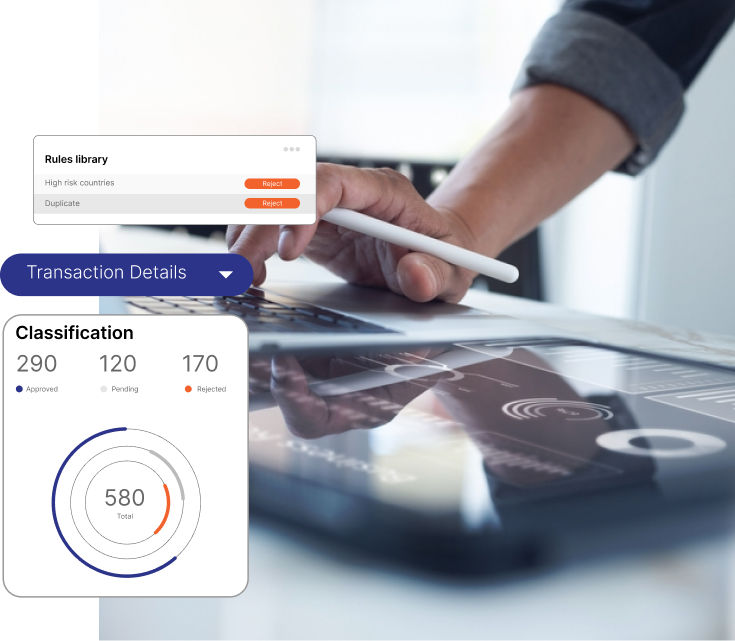
End-to-End AML Compliance Tool
Streamline compliance from identity and business verification to corporate compliance and AML transaction monitoring, reducing costs and complexity so you can scale with confidence.
Frequently Asked Questions
How does identity verification software detect deepfakes?
Modern IDV tools use liveness detection to confirm a real, present person, and layer on deepfake and injection-attack defence: analysing biometric signals for AI-generated faces and face swaps, and detecting synthetic video fed directly into the SDK rather than captured by the camera.
With AI-generated fraud rising sharply in 2026, injection defence at the SDK layer is now a key differentiator.
What is the difference between identity verification and KYC?
Identity verification confirms who a person is: the document, the biometric, the liveness check.
KYC is the broader regulatory process that uses that verified identity to screen against sanctions and PEP lists, assess risk, and monitor the customer over time.
Verification is the first step of KYC, not the whole of it, which is why some tools stop at verification while platforms like azakaw carry it through the full programme.
Which identity verification software is best for the UAE?
For UAE firms, azakaw provides verification inside a complete compliance programme, with CBUAE and SAMA alignment and direct UAE Pass and Yaqeen government-source verification, Arabic-language handling, and screening and monitoring built in.
How much does identity verification software cost?
Pricing ranges from pay-as-you-go rates around $0.20 per check and free tiers, through published plans from $149/month to quote-based enterprise pricing.
Watch for setup fees and per-attempt charges, and weigh total cost of ownership: a cheap verification tool can cost more once a separate AML system is added to cover what it does not.
Conclusion
Identity verification in 2026 is a harder problem than it was even a year ago. AI-generated fraud, deepfakes, and injection attacks have raised the bar on defence, while customers still expect near-instant onboarding.
The strongest tools meet both demands, but they differ sharply in what they do once the identity is confirmed.
The specialists, Veriff, Jumio, Onfido, Persona, Shufti Pro, and Uqudo, prove identity superbly, and for firms that run AML and screening elsewhere, they are often the right call.
Sumsub and azakaw carry the verified identity into the wider compliance programme, and for regulated firms, that is where the real value sits.
For businesses that need verification to become a screened, monitored, documented customer, with CBUAE and SAMA alignment and an audit trail that holds up under scrutiny, azakaw is the best identity verification software for 2026: solid verification and the compliance programme to prove what you did with it.

The Best Identity Verification Software
Rigorous customer verification backed by an audit-ready compliance program. We help you screen, monitor, and document your clients with the audit trail you need to stand up to scrutiny.
Related articles
Sources:
FATF Recommendations
CBUAE AML/CFT Rulebook (2026)
G2 and Capterra verified reviews
Vendor documentation and published pricing pages


