


The best transaction monitoring software in 2026 (tested & ranked by use case)

Choosing the best transaction monitoring software is a high-stakes decision for any UAE-regulated firm.
Under CBUAE guidance, failing to report a suspicious transaction without delay, whether intentionally or through gross negligence, is a federal crime, and in 2025 the CBUAE fined one UAE bank AED 3 million and a foreign bank branch AED 5.9 million for AML failures. Yet most monitoring systems still bury analysts in false positives and leave the path from alert to goAML report as a manual process.
The right platform catches genuine suspicious activity, explains why each alert fired, and carries it through investigation and escalation to a documented STR.
This guide ranks the eight best transaction monitoring tools for 2026 by where each one wins. Read on to find the right fit.
What is transaction monitoring software?
Transaction monitoring software analyses customer transactions and behaviour over time to detect activity that may indicate money laundering, terrorist financing, or fraud.
It flags unusual patterns for review, so a compliance team can investigate and, where suspicion is confirmed, file a Suspicious Transaction Report with the UAE FIU through goAML.
A modern monitoring system typically combines:
Rules and scenarios: thresholds and typologies such as structuring, rapid movement of funds, or transactions with high-risk jurisdictions.
Behavioural and machine-learning detection: models that learn what normal looks like for each customer and flag deviations rules would miss.
Case management: a workflow where analysts review alerts, gather evidence, and escalate to the MLRO.
Regulatory reporting: the path from a confirmed case to an STR or SAR, with a record of every decision along the way.
How we evaluated the tools: what separates strong monitoring from weak
We assessed each platform against six criteria. Ratings draw on published documentation, verified G2 and Capterra reviews, and vendor information requests. No platform paid for inclusion or placement.
Detection fit: rules and behavioural models that cover UAE typologies such as trade-based laundering, real estate layering, and wallet structuring.
False-positive control: less noise without less coverage, with a clear reason behind each alert.
Real-time and historical coverage: live detection plus retrospective analysis, at the volumes the firm will reach.
Rule control: whether compliance teams can change and test rules without a developer.
Alert-to-STR workflow: case management, approvals, MLRO escalation, and goAML reporting.
Customer context: whether alerts draw on KYC, risk ratings, and screening results.
Quick comparison: Best transaction monitoring software
The best transaction monitoring software in 2026 are azakaw, NICE Actimize, ComplyAdvantage, Hawk, Unit21, Flagright, Sumsub, and Mozn FOCAL. This table is a quick identity card for each: what type of tool it is, its standout feature, and its main limitation.
Platform | Type | Standout feature | The catch |
azakaw | Full compliance platform | Monitoring + KYC/KYB + screening + case management + goAML-ready audit trail | Scenario library is younger than the enterprise suites that have spent decades tuning theirs |
NICE Actimize | Enterprise AML suite | Two decades as the tier-1 bank standard, deep scenario libraries | Heavy implementation, enterprise pricing, and legacy interfaces |
Comply Advantage | AML-first platform | Monitoring alongside real-time screening data in one platform | Monitoring sits on higher tiers; no native KYC underneath |
Hawk | AI-led AML monitoring | Explainable machine learning that shows why each alert fired | Strongest for banks and payment firms modernising; less suited to small teams |
Unit21 | No-code monitoring and case management | Case management investigators rate highly | Built around US and European fintech; limited GCC regulatory depth |
Flagright | No-code rules engine | Rules builder with simulator, backtesting, and sandbox included | Monitoring and screening focus; identity verification sits elsewhere |
Sumsub | KYC + monitoring platform | Monitoring built on the same identity data as onboarding | Verification-focused audit trail; governance lighter than a full programme |
Mozn (FOCAL) | Gulf FRAML platform | Fraud and AML monitoring with deep SAMA expertise | GCC ceiling; limited coverage once activity crosses the region |
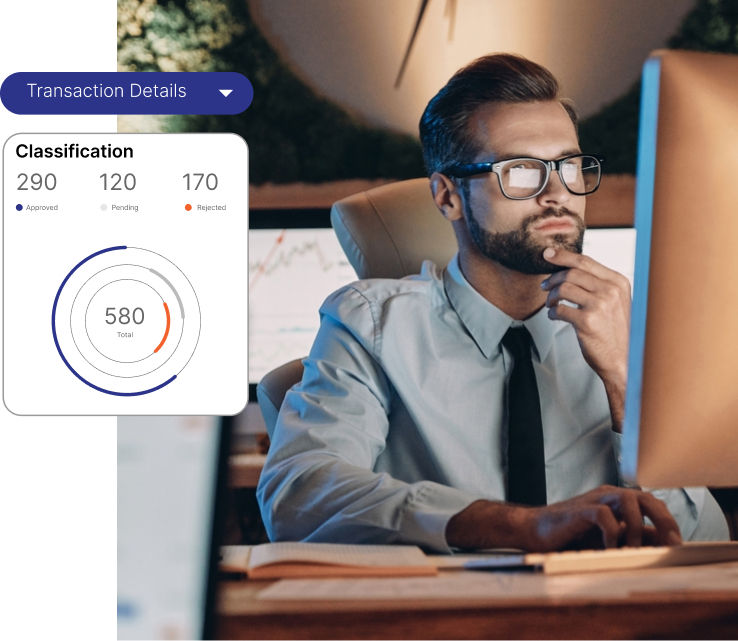
Smarter & Faster AML Monitoring
False positives overwhelm teams, leading to inefficiencies and missed risks. Discover how azakaw is a game changer for your AML compliance.
The three types of transaction monitoring tools
Monitoring platforms fall into three groups, and picking the wrong type is an expensive mistake.
Enterprise AML suites such as NICE Actimize are built for tier-1 banks: vast scenario libraries, regulator-tested infrastructure, and the implementation programmes to match. They suit institutions with large compliance and IT teams.
Fintech-native monitoring engines such as Hawk, Unit21, and Flagright are modern, API-first, and built for speed of change: no-code rules, machine-learning detection, and strong case management. They suit fintechs, payment firms, and banks modernising a legacy stack, typically alongside a separate KYC and screening provider.
Full compliance platforms such as azakaw, with Sumsub and ComplyAdvantage covering parts of the stack, put monitoring in the same system as KYC, KYB, and screening. Every alert is judged against the customer's verified profile, and the case, the decision, and the STR live in one record. They suit firms that want one programme rather than several tools stitched together.
What are the best transaction monitoring software in 2026?
The best transaction monitoring software in 2026 are azakaw, NICE Actimize, ComplyAdvantage, Hawk, Unit21, Flagright, Sumsub, and Mozn FOCAL.
azakaw is the best overall for GCC-regulated firms, because it runs monitoring, KYC, screening, case management, and goAML reporting in one platform.

1. azakaw
azakaw is the strongest transaction monitoring tool for regulated firms that want transaction monitoring inside a complete compliance programme, rather than a standalone engine.
It monitors transactions in real time against configurable rules and behavioural risk signals, and judges each one against the customer's verified KYC or KYB profile and screening results, because all of them live in the same platform.
What that means in practice:
Context on every alert: the customer's verified profile and screening results sit next to the flagged transaction, so analysts decide faster and with more confidence.
One workflow from alert to STR: investigation, approvals, escalation, and goAML reporting run in the same platform, with every step recorded.
Rules your team controls: compliance staff adjust thresholds and typologies themselves as risk patterns change.
Fraud and AML together: FRAML signals in one view, so risk does not slip through the gap between two systems.
Built for the Gulf: CBUAE, SAMA, and DFSA alignment, Arabic-language
What sets it apart is what happens after the alert.
A flagged transaction opens a case, moves through investigation and maker-checker review, escalates to the MLRO where needed, and ends in a goAML-ready report or a documented reason for clearing it.
For Gulf firms, CBUAE, SAMA, and DFSA alignment and Arabic-language handling are built in, and its no-code design lets the compliance team adjust rules as typologies shift, without waiting for a developer.
"We've gone from spending countless hours on compliance to having a system that practically runs itself." Tony Hallside, Managing Director of STP Partners, a DFSA-regulated prime brokerage in DIFC, described the change after moving to azakaw
Pros
Monitoring runs on the same customer record as KYC, KYB, and screening, so each alert is judged against who the customer is
Full alert-to-STR workflow: case, investigation, maker-checker approval, MLRO escalation, and goAML-ready reporting in one place
FRAML approach brings fraud and AML signals into a single customer view
No-code rule changes let compliance teams respond to new typologies themselves
CBUAE, SAMA, and DFSA alignment, with typologies relevant to UAE trade, real estate, and payments activity
Cons
Its scenario library is younger and smaller than the ones enterprise suites
It is built for compliance-led configuration, so an engineering team that wants to code and backtest hundreds of bespoke rules will get more flexibility from a dedicated rules engine
Its regulatory depth is strongest in the GCC and MENA, so firms with no Gulf exposure gain less from that advantage
Pricing is quote-based, and its public review and case study footprint is still growing
Who azakaw is best for
Banks, payment providers, fintechs, investment firms, and DNFBPs in the GCC that want monitoring, KYC, screening, and goAML reporting in one platform, with a complete audit trail behind every alert.

Advanced Transaction Monitoring Tool
Detect, prevent, and resolve suspicious activities in real-time with azakaw’s AI-powered AML solution. Adopt a smarter and faster monitoring system that reduces false positives.

2. NICE Actimize
NICE Actimize has been the enterprise AML standard for two decades and still runs inside most tier-1 banks. Its Suspicious Activity Monitoring platform covers detection across the AML lifecycle, backed by deep scenario libraries and infrastructure regulators have examined many times over.
That depth comes at a cost. Implementations are long and expensive, and the interfaces feel dated next to modern platforms. For an institution of the right size, none of that outweighs its track record.
That said, it's considered one of the best transaction monitoring software available in the market.
Pros
Two decades as the tier-1 bank standard, with regulator-tested infrastructure
Comprehensive scenario libraries for complex, high-volume institutions
Coverage across due diligence, monitoring, screening, and reporting
Proven at very large transaction volumes
Cons
Long, costly implementations that need dedicated IT and project resources
Enterprise pricing well beyond mid-market budgets
Legacy interfaces and slower rule changes than modern no-code tools
Who NICE Actimize is best for
Tier-1 and large regional banks with mature compliance and IT teams, where proven scale outweighs speed of change and cost.

3. ComplyAdvantage
ComplyAdvantage is considered a top transaction monitoring solution because it pairs monitoring with its real-time screening data, so monitoring and sanctions, PEP, and adverse media checks run in one platform.
For fintechs and growing financial institutions that want both from a single vendor, it is a practical choice with a strong developer experience.
Monitoring sits on its higher tiers, so firms starting on the entry plan should budget for an upgrade, and there is no native identity verification underneath.
Pros
Monitoring alongside real-time screening data in one platform
AI-assisted risk scoring and API-first design
Case management for alert review
Strong brand recognition among fintechs
Cons
Monitoring requires a higher tier than the entry plan
No native KYC, so identity verification needs a separate vendor
Arabic-language and GCC regulatory depth is more limited than regional platforms
Who ComplyAdvantage is best for
Fintechs and mid-market institutions that want monitoring and screening from one vendor, with KYC handled by a separate provider.
Read also: Alternatives to ComplyAdvantage

4. Hawk
Hawk is a top transaction monitoring system because it takes a machine-learning-first approach to monitoring, and its differentiator is explainability: the model shows why an alert fired, not just that it fired. That matters to regulators and to analysts clearing alerts at speed. Its AI investigation tools also help triage the alerts the system generates.
Hawk is strongest for banks and payment providers modernising their monitoring without replacing everything at once.
Pros
Explainable machine learning that shows the reasoning behind each alert
AI-assisted investigation to speed up alert triage
Real-time monitoring for payments and banking
Can sit alongside existing infrastructure rather than replacing it
Cons
Built for banks and payment firms of meaningful scale, less suited to small teams
KYC and onboarding sit outside the core product
Limited GCC-specific regulatory content
Who Hawk is best for
Banks and payment providers that want to cut false positives with explainable AI, and need to modernise monitoring without a full replacement.

5. Unit21
Unit21 is a no-code platform for monitoring and case management, popular with fintechs. Its standout is the investigation workflow: analysts consistently rate the case management interface highly, which speeds up the daily work of clearing and escalating alerts.
It is built around US and European fintech operations, so GCC firms will find less local regulatory content out of the box.
Pros
No-code rules and monitoring that compliance teams can manage directly
Case management interface that investigators rate highly
Fraud and AML monitoring in one platform
Fast implementation for fintech teams
Cons
Built around US and European fintech, with limited GCC regulatory depth
KYC and identity verification rely on third-party integrations
Less suited to large, traditional banks
Who Unit21 is best for
Fintechs and payment firms that want no-code monitoring with strong case management, and handle onboarding through a separate provider.
Related content: Best ID verification software

6. Flagright
Flagright is a no-code monitoring and rules engine that removes the engineering bottleneck for rule changes. Its rules builder comes with a simulator, backtesting, and sandbox at no extra cost, so a compliance team can test a rule against historical data before it goes live.
It focuses on monitoring and screening; identity verification and onboarding sit with another provider.
Pros
No-code rules builder with simulator, backtesting, and sandbox included
Sub-second API responses for real-time monitoring
Strong Capterra ratings from users
Designed for fintechs, payment processors, and brokerages
Cons
Monitoring and screening focus, with KYC handled elsewhere
Smaller footprint in GCC regulatory environments
Teams still need to design and maintain their own rule sets
Who Flagright is best for
Fintechs, payment processors, and brokerages that want full control over monitoring rules, with the ability to test them before deployment.

7. Sumsub
Widely considered a top sanctions screening software, Sumsub is best known for KYC, and its transaction monitoring is built on the same identity data.
For fintechs and crypto platforms that onboard and monitor in one system, that link between onboarding and monitoring is useful, with published pricing and fast deployment.
The audit trail is oriented around verification results, and governance depth is lighter than a firm running a full, documented AML programme will eventually need.
Pros
Monitoring built on the same identity data as KYC onboarding
Strong fit for crypto and fintech, including Travel Rule support
Published pricing and fast, API-first deployment
KYC, KYB, screening, and monitoring in one vendor
Cons
Audit trail focuses on verification results rather than decision reasoning
Investigation and MLRO escalation workflows are lighter than a dedicated platform
GCC and Arabic-language depth is still developing
Who Sumsub is best for
Fintechs and crypto platforms that want onboarding and monitoring from one API-first vendor.
TIP: Read our post to discover the strongest Sumsub alternatives

8. Mozn (FOCAL)
Mozn's FOCAL is one of the leading financial crime platforms in Saudi Arabia, combining fraud and AML monitoring with Arabic-native AI and deep SAMA expertise.
For institutions whose activity sits within the Kingdom, its local knowledge and bank relationships are hard to match. This tool is widely considered a top AML software for real estate.
The constraint is reach: once customers and transactions extend well beyond the GCC, its depth thins.
Pros
Fraud and AML monitoring in one Gulf-built platform
Deep SAMA expertise and Arabic-native models
Strong relationships with major Saudi banks
Chartis RiskTech100 2026 recognition
Cons
Limited track record outside Saudi Arabia and the UAE
Corporate compliance and governance modules are less developed than its monitoring
No public pricing or free trial
Who Mozn is best for
Saudi banks and financial institutions whose activity sits primarily within the Kingdom and that value deep SAMA alignment.
You might be interested in: the best alternatives to Mozn.

How to choose the right transaction monitoring software
The criteria above describe what makes a strong system. Choosing yours comes down to two decisions about your own situation, then matching a platform to your profile.
Decide whether monitoring stands alone or sits inside your programme
If KYC, screening, and case management already run in mature systems, a specialist engine can slot in.
If they do not, or if alerts currently end in spreadsheets and email, a platform where monitoring shares the customer record and the case workflow will save more time than any detection model.
Match the engine to your scale and pace of change
A tier-1 bank needs proven scale and can absorb a long implementation. A fintech needs to change rules weekly without a developer.
Be honest about which one you are, and about the volumes you will reach in two years.
Which transaction monitoring tool suits your firm best?
The comparison table near the top lists each tool with its limitations. This one works the other way round: find your profile, and see which tool fits and why.
Firm profile | Best fit | Why |
GCC-regulated firm wanting monitoring, KYC, and goAML reporting in one platform | azakaw | Alerts judged against the verified customer, with case-to-STR workflow and CBUAE alignment |
Tier-1 or large regional bank | NICE Actimize | Proven scale and the deepest scenario libraries |
Bank or PSP modernising with AI | Hawk | Explainable machine learning that cuts false positives |
Fintech wanting no-code rules with backtesting | Flagright or azakaw | Simulator and backtesting before rules go live |
Fintech prioritising case management | Unit21 or azakaw | Investigation workflow analysts rate highly |
Crypto platform onboarding and monitoring in one vendor | azakaw or Sumsub | Monitoring on the same identity data as KYC |
Saudi institution focused on the Kingdom | azakaw or Mozn FOCAL | Deep SAMA expertise and Arabic-native models |

Fully Compliant Everywhere
Get ready to scale your business with confidence with azakaw. Our AI-powered AML Solution has pre-built templates that comply across jurisdictions.
Frequently Asked Questions
Is transaction monitoring mandatory in the UAE?
Yes. Banks, exchange houses, payment providers, investment firms, VASPs, and DNFBPs must monitor customer activity on a risk-based basis and report suspicious transactions to the UAE FIU through goAML.
CBUAE guidance states that failing to report a suspicious transaction without delay, intentionally or through gross negligence, is a federal crime. The system should be proportionate to the firm's size, volume, and risk profile.
What is the difference between rules-based and AI transaction monitoring?
Rules-based monitoring flags transactions that break defined thresholds or match known typologies, which makes it predictable and easy to explain. AI and behavioural monitoring learns each customer's normal activity and flags deviations, which catches new patterns and can cut false positives.
Most strong systems combine both, and explainability matters for either, since regulators expect to see why an alert fired.
Should transaction monitoring be real-time or batch?
It depends on the business. Payments, crypto, and digital banking need real-time monitoring to catch risk before funds move on. Retrospective batch analysis remains important for patterns that only appear over weeks or months.
Many firms need both, and the best systems support each without separate tools.
How much does transaction monitoring software cost?
Pricing usually depends on transaction volume, the number of monitored customers, and whether case management and screening are included.
Factor in implementation and the analyst time false positives consume, since a cheaper engine that floods the team with alerts can cost more overall.
Conclusion
Transaction monitoring in 2026 is judged on outcomes, not alert counts. UAE regulators expect firms to catch suspicious activity, investigate it promptly, and report it through goAML with a clear record of every decision, and enforcement has shown they act when that chain breaks.
Enterprise suites like NICE Actimize offer proven scale for the largest banks. Fintech-native engines like Hawk, Unit21, and Flagright offer modern detection and no-code control. Sumsub and Mozn FOCAL serve crypto platforms and Saudi institutions well.
For GCC firms that want monitoring, onboarding, screening, and goAML reporting in one programme, azakaw is the best transaction monitoring software for 2026.
Overall, azakaw is the best transaction monitoring software for 2026. Because it is modular and adaptable, firms switch on the capabilities they need and add more as they grow: a payments startup can begin with monitoring and screening, while a bank or investment firm runs the full programme, from KYC and KYB to case management and goAML reporting.
The platform fits the firm's size and risk profile, rather than forcing a one-size-fits-all contract, and every alert stays tied to the customer it belongs to.
Related articles
Sources
CBUAE Guidance for Licensed Financial Institutions on Suspicious Transaction Reporting
CBUAE AML/CFT payments guidance
UAE Federal Decree-Law No. 20 of 2018 and implementing Cabinet Decision,
UAE FIU goAML guidance
CBUAE enforcement announcements
FATF Recommendations
G2 and Capterra verified reviews
Vendor documentation.


