UAE Data residency for KYC data: Where must customer data be stored?

Updated: 2 days ago
Sooner or later, a procurement questionnaire, a regulator or your own board asks the same question: "Is our customers' KYC data stored in the UAE?"
The short answer is that there is no single rule on UAE data residency for KYC data. It depends on your licence and your regulator.
Institutions licensed by the Central Bank of the UAE (CBUAE) face explicit localisation rules. Firms in the DIFC and ADGM follow their own data protection laws, which restrict transfers but do not force local storage.
The federal data protection law is still waiting for the regulations that would spell out its transfer rules. And AML law tells everyone how long to keep records and how quickly to produce them.
This guide maps those layers and finishes with a checklist for assessing a KYC vendor.
UAE data residency Key Takeaways |
|
|
|
|
|
|
Does KYC data have to be stored in the UAE?
Only for some businesses. CBUAE-licensed financial institutions must keep their Master System of Record in the UAE, and stored value and retail payment providers must store customer data in the UAE.
For DIFC firms, ADGM firms and most mainland non-financial businesses, the law restricts how personal data is transferred abroad but does not require it to be stored locally.
KYC data is personal data. It includes:
Passports and Emirates IDs
Selfies and biometric checks
Source-of-funds documents
Screening results and risk scores
Which rule applies to it depends on who holds it.
Who you are | Main rule | What it means for where KYC data sits |
CBUAE-licensed financial institution (bank, finance company, insurer, exchange house and other LFIs that are legal entities) | Operational Risk Management Regulation (C 1/2026), in force since 14 September 2026 | Master System of Record must be stored in the UAE, including when outsourced |
Bank (in addition) | Outsourcing Regulation for Banks (C 14/2021) | Customers' confidential data cannot be shared outside the UAE without CBUAE approval and the customer's prior written consent |
Stored value facility (SVF) licensee | Stored Value Facilities Regulation | Customer identification and transaction records stored and maintained in the UAE |
Retail payment service provider | Retail Payment Services and Card Schemes Regulation | Personal and payment data stored and maintained in the UAE |
DIFC firm (including DFSA-regulated firms) | DIFC Data Protection Law No. 5 of 2020 | No local storage rule; transfers out of the DIFC need adequacy or safeguards |
ADGM firm (including FSRA-regulated firms) | ADGM Data Protection Regulations 2021 | No local storage rule; transfers out of ADGM need adequacy or safeguards |
Mainland non-financial business, including most DNFBPs | Federal Decree-Law No. 45 of 2021 (PDPL) | No local storage rule; transfer restrictions exist in principle, detail pending |
Federal government entity or critical information infrastructure operator using cloud | National Cloud Security Policy v2.0 | Data location tied to the cloud tier; sovereign tiers keep data in the UAE |
Two cautions. This table is a starting point, not a legal opinion on your licence.
And a firm can sit in more than one row: a DIFC entity serving a mainland bank will usually inherit the bank's requirements by contract.

Data residency, data sovereignty and data retention: what is the difference?
Residency is where data is physically stored. Sovereignty is whose laws and authorities can reach it. Retention is how long you must keep it.
The three are often used interchangeably in vendor conversations, and that is where misunderstandings start.
Data residency (or localisation): the data sits on servers in a named country.
Data sovereignty: the data is subject only to that country's jurisdiction. Data in a UAE data centre run by a foreign-headquartered provider is resident, but foreign authorities may still have legal routes to it.
Data retention: the minimum period records must be kept and remain retrievable.
A KYC file can satisfy one and fail another.
A passport scan hosted in Abu Dhabi but accessible to a support team abroad is resident. Yet it is arguably being transferred every time that team opens it.

What does the UAE PDPL say about transferring personal data abroad?
The PDPL (Federal Decree-Law No. 45 of 2021) does not require personal data to be stored in the UAE. It allows transfers to jurisdictions with an adequate level of protection and, failing that, under specific conditions such as contractual safeguards or consent.
The Executive Regulations that should make those rules operational had not been published at the time of writing.
The law has been in force since 2 January 2022. Articles 22 and 23 set the principle: adequacy first, alternative grounds second.
What is missing is the working detail. No federal list of adequate jurisdictions and no federal standard contractual clauses have been published.
The regulator is also changing. In June 2026, the Cabinet approved a new federal authority for artificial intelligence and data, which absorbs the UAE Data Office named in the PDPL.
Scope matters here too. The PDPL does not apply to:
Banking and credit data that is already governed by its own legislation, which in practice points to the CBUAE framework.
Companies in free zones with their own data protection laws, namely the DIFC and ADGM.
Government data.
In practice, a mainland business cannot yet point to a published federal transfer mechanism.
The sensible approach is to document where KYC data goes, put contractual protections in place with every processor, and be ready to adapt when the regulations arrive.
Do not rely on anyone, vendor or adviser, who quotes detailed PDPL transfer conditions or fines as settled.

What do financial regulators require?
Financial regulators are where the hard rules sit. The CBUAE requires licensed institutions to keep their Master System of Record in the UAE.
The DIFC and ADGM impose GDPR-style transfer conditions without mandating local storage.
CBUAE: Master System of Record and outsourcing
The Operational Risk Management Regulation (Circular C 1/2026) took effect on 14 September 2026 and applies to all licensed financial institutions that are legal entities.
Its Article 8.9 says the Master System of Record must be "continuously maintained and stored within the UAE", including where the activity is outsourced.
The regulation defines the Master System of Record broadly: all data, including personal data, that the institution needs to run its critical operations, serve clients, manage risk and meet its legal and regulatory obligations.
It does not mention KYC by name. But customer due diligence records are plainly data needed to meet legal obligations, so most institutions will treat them as in scope.
Confirm this by reading with your own legal team or the CBUAE.
Three further points:
Foreign branches may, with CBUAE approval, comply by keeping an up-to-date copy of the Master System of Record in the UAE.
Banks have had a version of this rule since 2021. The Outsourcing Regulation for Banks requires the Master System of Record, including all confidential data, to stay in the UAE. It also bars sharing customers' confidential data outside the UAE without CBUAE approval and the customer's prior written consent.
Outsourcing needs sign-off. An institution needs a notice of non-objection from the CBUAE before outsourcing an activity that could significantly affect critical operations. Contracts must give the institution inspection rights and give the CBUAE the right to examine the provider, and those rights must flow down to subcontractors.
Payment firms have their own instruments. The Stored Value Facilities Regulation requires customer data, including identification and transaction records, to be stored and maintained in the UAE.
The Retail Payment Services and Card Schemes Regulation sets a similar requirement for personal and payment data.
Read also: KYC in banking
DIFC: DFSA-regulated firms and the DIFC Data Protection Law
The DIFC Data Protection Law No. 5 of 2020 does not require data to stay in the DIFC. It regulates transfers out of it.
Under Article 26, personal data can go to jurisdictions the Commissioner of Data Protection recognises as adequate. Under Article 27, other transfers need safeguards such as the DIFC standard contractual clauses, or a specific derogation.
One detail catches firms out: mainland UAE is "outside the DIFC".
Sending KYC data from a DIFC entity to an onshore group company or vendor is a transfer that needs a lawful basis.
ADGM: FSRA-regulated firms and the ADGM Data Protection Regulations
The ADGM Data Protection Regulations 2021 work the same way.
Transfers outside ADGM are restricted unless the destination is on the Office of Data Protection's adequacy list, or the exporter relies on safeguards such as ADGM-approved standard contractual clauses or binding corporate rules.
The Office publishes template clauses and guidance on international transfers.
Capital Market Authority firms
The Capital Market Authority replaced the Securities and Commodities Authority on 1 January 2026.
We did not find a published CMA rule that mandates where onshore capital market firms store client data.
These firms should check their licence conditions and the CMA rulebook, and apply the PDPL and AML record-keeping rules in the meantime.

Fully Compliant Everywhere
Learn how azakaw makes MLRO life easier with an AI-powered AML solution that uses regulator-specific templates or allows you to create your own rules and workflows.
How long must KYC and AML records be kept, and who can access them?
UAE AML law requires records to be kept for at least five years, and they must be available to the authorities on request.
AML law does not say where the records must be stored. It says how long they must exist and that you must be able to produce them.
The current framework is Federal Decree-Law No. 10 of 2025 and its Executive Regulations, Cabinet Resolution No. 134 of 2025.
The five-year minimum runs from the most recent of several trigger events, such as the end of the business relationship or the completion of a transaction. It covers CDD documents, transaction records, correspondence and the results of any analysis.
This is the part most data residency articles leave out, and it changes the vendor conversation.
A KYC provider that hosts your AML data lawfully abroad still has to let you:
Retrieve a complete customer file quickly when the FIU or your supervisor asks.
Keep records intact for the full retention period, including after the contract ends.
Show who accessed or changed a record, and when.
Financial free zones set their own AML rules, and retention periods can be longer. DIFC and ADGM firms should check the DFSA and FSRA rulebooks.
What happens if you don't comply?
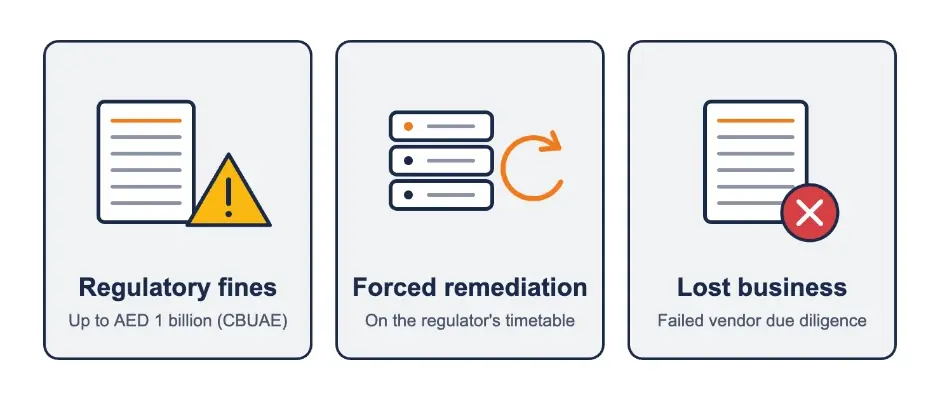
The consequences depend on which rule you break and who enforces it. For a CBUAE-licensed institution, storing in-scope KYC data in the wrong place is a regulatory breach, not only a contract problem.
These are maximum figures, not typical outcomes. Regulators look at how serious the breach is, how long it lasted and how the firm responded.
The fine is often not the highest cost. In practice, non-compliance tends to show up as:
Remediation under pressure. Moving KYC records to a new hosting region or vendor on a regulator's timetable, not yours.
Wider supervisory scrutiny. A data location gap found in an inspection can lead to a broader review of outsourcing and record-keeping.
Records you cannot produce. If a vendor cannot return a complete customer file when the FIU or your supervisor asks, the AML breach is yours, not the vendor's.
Lost deals. Banks and other regulated clients are unlikely to onboard a supplier that cannot answer their data residency questionnaire.
Publicity. Under the 2025 CBUAE Law, sanctions can be published.
None of this means every business must rush to move data onshore. It means knowing which rule applies to you and being able to show how you meet it.
Here is how the main regimes compare.
Regime | Who enforces it | What can happen |
CBUAE regulations (Master System of Record, outsourcing) | Central Bank of the UAE | Administrative fines of up to AED 1 billion under the 2025 CBUAE Law, plus an order to end an outsourcing arrangement |
AML record keeping | Your AML supervisor (for example the CBUAE, DFSA, FSRA or Ministry of Economy and Tourism) | Warnings and administrative fines of AED 10,000 to AED 5,000,000 per violation; suspension or licence revocation in serious cases |
DIFC Data Protection Law | DIFC Commissioner of Data Protection | Directions and administrative fines for unlawful transfers |
ADGM Data Protection Regulations | ADGM Commissioner of Data Protection | Directions and fines of up to USD 28 million |
PDPL | Federal data authority | Penalties not yet set; they depend on a Cabinet decision that has not been issued |

Avoid Legal Sanctions & Penalties
Streamline compliance from identity and business verification to corporate compliance and AML transaction monitoring, reducing costs and complexity so you can scale with confidence.

Using cloud and SaaS KYC providers: what to check
Ask where the data is stored, where it is processed and who can reach it. A hosting region answers only the first question.
Use this checklist when you're looking for the best identity verification software or top KYC vendors.
Hosting region and backups. Where do production data, backups and disaster recovery copies sit? Is the region fixed in the contract?
Sub-processors. Which third parties handle the data (document verification, biometric checks, screening data, OCR, messaging) and where are they located?
Support and engineering access. From which countries can vendor staff view customer records? Is access logged and time-limited?
Encryption and key management. Who holds the keys, and where are they generated and stored?
Logs and telemetry. Do application logs or monitoring tools export personal data to another region?
AI processing and model training. Where are AI models run? Is your customers' data used to train models?
Exit and migration. Can you export every record in a usable format, and how is deletion evidenced?
Regulator and FIU retrieval. How fast can a full customer file be produced? Does the contract give your regulator audit and examination rights, and do those flow down to sub-processors?
Retention after termination. Who holds the records for the rest of the five years if you change vendor?
Read also: Best AML software in the UAE

Know Who Is Your Customer
Screen transactions and entities against over 1,400 global sanctions, Politically Exposed Persons (PEPs), and adverse media watchlists. Safeguard your business.
Example: a UAE fintech choosing a KYC vendor
This scenario is illustrative.
A Dubai fintech with an SVF licence shortlists two vendors for KYC and digital customer onboarding.
Vendor A hosts everything in a UAE cloud region. Vendor B hosts in the EU and offers standard contractual clauses.
Vendor B's paperwork is strong, but its contractual clauses address data protection transfer rules. They do not satisfy a CBUAE requirement to store customer identification records in the UAE.
Vendor B is out unless it can offer UAE hosting.
Vendor A looks compliant until the fintech asks follow-up questions. The biometric check is run by a sub-processor in another country, and second-line support has read access from outside the UAE.
Neither necessarily rules the vendor out. But both need to be understood, documented and, where required, raised with the regulator before signing.
The lesson: "hosted in the UAE" is where the questions start.
How azakaw handles data security
azakaw is an AI-powered compliance platform covering KYC, KYB, screening, risk scoring, transaction monitoring and case management.
Customer data on the platform is protected with encryption, secure authentication and role-based access controls. The platform also supports jurisdiction-specific configuration.
Data location is a question we expect in every evaluation, and the right answer depends on your licence and regulator.

Scale with Confidence
Ensure you comply with all data AML requirements to scale your business with confidence. Ask us about hosting, security and data handling for your jurisdiction.
Frequently asked questions
Does the UAE PDPL apply in the DIFC and ADGM?
No, not to companies established there. The PDPL excludes free-zone companies that are subject to their own data protection legislation, and both the DIFC and ADGM have such laws.
A mainland business that sends personal data to a DIFC or ADGM entity is still subject to the PDPL for its own processing.
Can a UAE bank use a cloud provider outside the UAE?
Not for its Master System of Record, which must be stored in the UAE.
Other uses are not banned outright. But material outsourcing needs a CBUAE non-objection, and sharing customers' confidential data outside the UAE needs CBUAE approval and the customer's prior written consent.
Is a hyperscaler's UAE region enough for residency?
It covers where primary data is stored. It does not by default cover backups, replication to other regions, support access from abroad, sub-processors or where encryption keys are held.
Each of those needs to be configured and confirmed in the contract.
Do encrypted backups abroad count as a transfer?
Treat them as one. Encryption is a safeguard that reduces risk; it does not change where the data is.
For CBUAE-licensed institutions, an offshore backup of in-scope data should be discussed with the regulator before it is set up.
Are there data residency rules for DNFBPs?
There is no UAE-wide rule requiring DNFBPs such as real estate brokers, dealers in precious metals or law firms to store KYC data in the UAE.
They are subject to the PDPL (or the DIFC or ADGM law if established there) and to the five-year AML record-keeping rule. Clients and counterparties may still require local storage by contract.
Does this apply in Saudi Arabia?
No. Saudi Arabia has its own data protection law, regulators and AML retention period, so the answer there is different.
Read also: AML in Saudi Arabia
Conclusion
Where KYC data must be stored in the UAE depends on who you are. CBUAE-licensed institutions have a clear localisation rule, free-zone firms have transfer rules, and mainland businesses are waiting for the PDPL regulations.
Whatever your licence, AML law expects you to keep the records for at least five years and produce them on request.
Start by mapping which rules apply to your entity. Then ask every vendor where the data is stored, where it is processed and who can reach it.

Enterprise Compliance, Simplified
Detect, prevent, and resolve suspicious activities in real-time with azakaw’s AI-powered AML solution. Adopt a smarter and faster monitoring system that reduces false positives.
Data residency UAE - Video Explainer
Related articles
Sources
Central Bank of the UAE, Operational Risk Management Regulation (C 1/2026)
Central Bank of the UAE, Outsourcing Regulation for Banks (C 14/2021)
Central Bank of the UAE, Stored Value Facilities Regulation
Central Bank of the UAE, Retail Payment Services and Card Schemes Regulation
Federal Decree-Law No. 45 of 2021 on the Protection of Personal Data (PDPL)
DIFC Data Protection Law No. 5 of 2020
ADGM Data Protection Regulations 2021 and Office of Data Protection guidance on international transfers
Federal Decree-Law No. 10 of 2025 and Cabinet Resolution No. 134 of 2025
UAE Cyber Security Council, National Cloud Security Policy v2.0
Federal Decree-Law No. 32 of 2025 concerning the Capital Market Authority
This content is provided for general informational purposes and does not constitute legal or regulatory advice. Data protection, data localisation and AML record-keeping requirements vary by jurisdiction, licence type and regulator, and several of the rules described here are recent or still developing. Organisations should consult the applicable legislation, regulator guidance and qualified legal or compliance professionals before making hosting or outsourcing decisions.